



IR Information
Manufacturing and Procurement Cross-Functional Strategy Supporting Business Growth Fuji Electric Report 2026
Profile
Fuji Electric’s Reason for Existence0.2MBPDF Business Areas and Strengths0.8MBPDF History of the Energy and Environment Businesses0.6MBPDF Value Creation Process0.3MBPDFTop Message
Message from the Chairman of the Board and CEOWEB Interview with the President and COOWEBManagement Foundation
Important Issues for Management (Materiality)0.6MBPDF Progress of Management Reforms0.1MBPDFBusiness Planning and Financial Strategy
Progress of the FY2026 Medium-Term Management Plan0.2MBPDF Financial and Capital StrategiesWEBOverview of Segments
Basic InformationWEB EnergyWEB IndustryWEB SemiconductorsWEB Food and Beverage DistributionWEBCross-Functional Strategy Supporting Business Growth
Research and Development / Intellectual PropertyWEB Manufacturing and ProcurementWEB EnvironmentWEB Human ResourcesWEB Respect for Human Rights0.2MBPDFManufacturing and Procurement
“Improving productivity and strengthening the supply chain by utilizing digitization and AI technologies”
We have been expanding profits through productivity improvements achieved by drawing on our manufacturing strengths: "Strong On-site Capabilities and Advanced Production Technologies," "Optimal Global Production Collaboration," and "Human Resource and Team Capabilities by Cultivating Engineers and Skilled Workers." We view recent changes in the external environment, including geopolitical risks, rising costs, labor shortages, and climate change, as an opportunities for transformation through "manufacturing DX" utilizing digitization and AI technologies. For materials and components, we are accelerating efforts to strengthen resilience by multi-sourcing our procurement supply chain and reshoring production to Japan, as well as efforts to develop alternative materials and shift to resource-circulation-oriented design, with the aim of building a stable procurement system and reducing costs.
In addition, practicing "Sustainable Procurement" based on co-existence and mutual prosperity with our business partners is one of our most important management priorities. We will ensure consideration for human rights and the environment throughout the supply chain in accordance with the Fuji Electric CSR Procurement Guidelines, and we will build strong relationships of trust that enable us to grow together while fulfilling our social responsibilities.
Going forward, with further productivity improvements through digitization and AI technologies and a resilient procurement base as the two pillars of our efforts, we will continue to improve quality and profitability while reducing environmental impacts, thereby aiming to sustainably enhance corporate value.
The Strengths of Fuji Electric’s Manufacturing
Strong On-site Capabilities
and Advanced Production
Technologies
Optimal Global Production
Collaboration
Human Resource and Team
Capabilities by Cultivating
Engineers and Skilled Workers
Manufacturing Initiatives
The Evolution of Manufacturing to Respond to Changes in the Environment
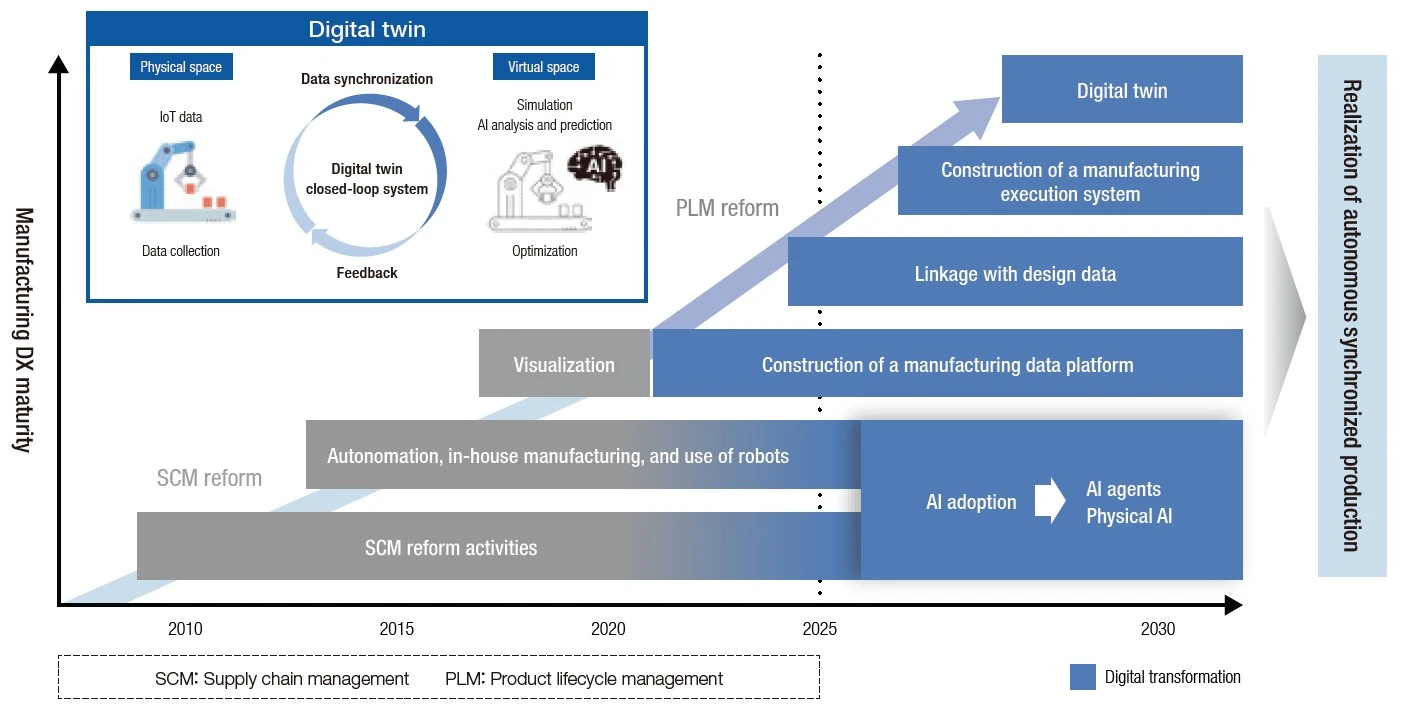
By digitally integrating PLM*1, which manages product lifecycles, with SCM, which manages supply chains, we will build an "IoT-Linked Smart Factory" that optimizes processes from development through production. We will also introduce automation technologies based on co-creation between people and AI into parts processing and assembly processes to increase our product supply capacity, while aiming to improve productivity, reduce costs, and enhance quality.
*1 PLM: Product lifecycle management
Concurrent Development Through PLM Reform and SCM Integration
Concurrent development through PLM reform and SCM integration incorporates on-site manufacturing expertise from the early stages of design, with 3D models shared in the PLM system and analyzed by AI. In a virtual environment, the manufacturing division can verify "ease of manufacture," while the procurement division can verify "parts availability." This shortens development lead times through work process optimization and a significant reduction in rework hours arising from downstream processes. In addition, by linking design and manufacturing data and building a mechanism whereby design changes are immediately reflected in procurement and production plans, we will improve data consistency, eliminate waste in administrative work, and raise productivity in indirect functions. These initiatives will not only improve operational efficiency but also serve as a mechanism that automatically drives overall optimization of product quality, cost, and delivery.
Improving Productivity by Advancing Production Technologies (Use of AI)
We are working to increase production capacity by advancing our production technologies, executing timely plant and equipment investments, and strengthening our global production systems. In fiscal 2025, we are using AI for applications such as predictive maintenance that detects equipment failures in advance and the automation of visual inspections, thereby increasing equipment operating rates and production volumes.
In using generative AI, we digitize the tacit knowledge of skilled workers and achieve automation through automatic corrections using the "AI Assistant" function. In the future, we will incorporate intelligent robots that make use of physical AI into our equipment to automate the picking of irregularly shaped items and complex assembly work.
Through these initiatives, by fiscal 2026, we will achieve a 20% improvement in productivity compared to the fiscal 2023 level, increasing production volumes and addressing labor shortages. Looking further ahead, we will use "digital twins" to reproduce information and data from physical space in virtual space and feed the results of AI-based simulations and verification back into physical space, taking on the challenge of achieving autonomously synchronized production sites that never stop.
Automating Skill-Intensive and Difficult Tasks Using CAD Data and AI
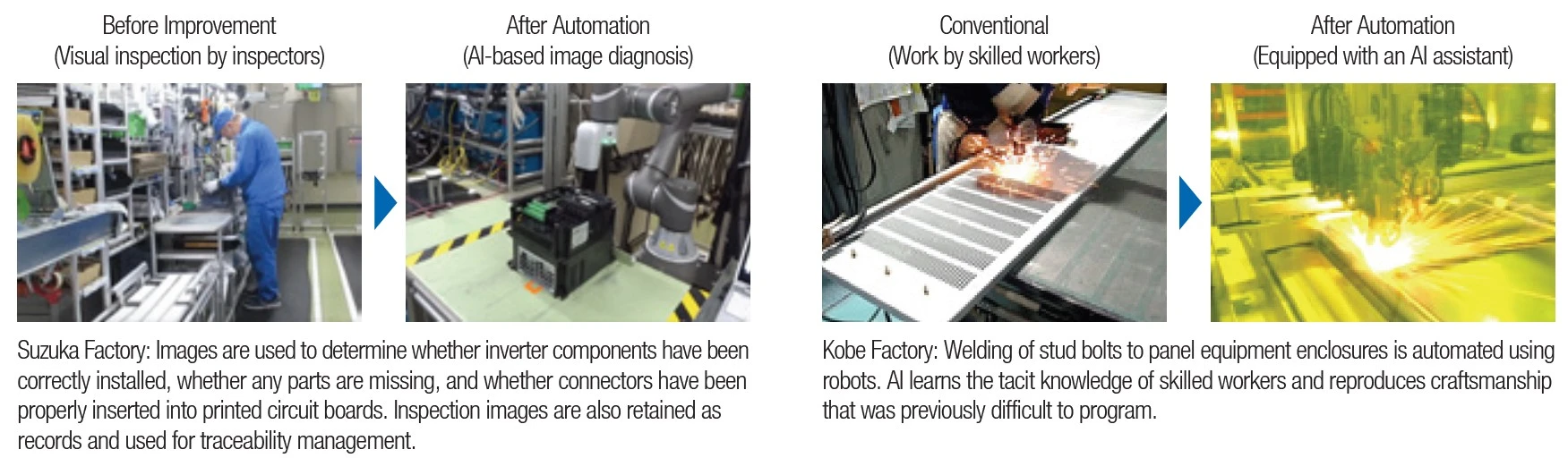
Kobe Factory: Welding of stud bolts to panel equipment enclosures is automated using robots. AI learns the tacit knowledge of skilled workers and reproduces craftsmanship that was previously difficult to program.
Initiatives to Improve Quality
As for quality, each year we formulate the High Reliability Activities Policy and apply it to each business division and factory to promote improvement activities. To enhance the degree of product refinement at the development and design stages, we incorporate plans to acquire new technologies into our design reviews, in addition to the technologies already possessed by our factories and development divisions. We also focus on changes and modifications that arise during design and, in addition to reviews by experts, utilize generative AI technology to identify omissions in analysis and verification, thereby reducing quality risks.
For process quality, we conduct internal quality audits at each factory to assess the management status of our manufacturing processes. In addition, we carry out mutual diagnoses by experts from other factories, and we reflect the results and findings in our frameworks and rules to improve our quality control standards.
Sustainable Procurement
By identifying, assessing, and addressing supply chain risks, we aim to build stable material procurement and CSR procurement over the medium and long terms.
CSR Procurement Initiatives
Based on our basic policy of co-existence and mutual prosperity with our business partners, we work to promote their understanding of our CSR approach and the initiatives they should observe and implement according to the "Fuji Electric CSR Procurement Guidelines." Through these efforts, we aim to reduce CSR risks throughout the supply chain and create business opportunities.
1. Human Rights and Labor
2. Health and Safety
3. Environment
4. Fair Trade and Ethics
5. Quality and Safety
6. Information Security
7. Business Continuity Plan
8. Establishment of Management Systems
9. Social Contribution
Self-Assessment of CSR Procurement
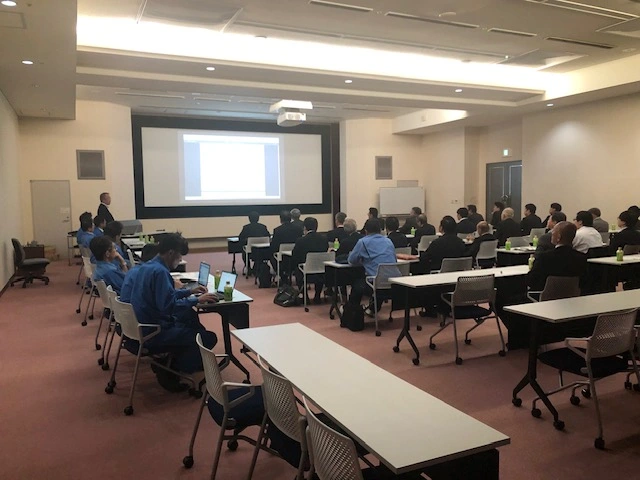
To understand the status of our business partners' CSR initiatives and improvements, we conduct an annual CSR self-assessment. We also hold briefings and interviews with business partners to share issues and promote collaborative improvement activities.
In fiscal 2025, we conducted assessments of 893 business partners, which accounted for the top 80% of our purchases over the last three years. The number of Rank A business partners increased by 25 year on year to 807, reflecting improved results. In fiscal 2026, we plan to assess 900 business partners, and we will continue to promote thorough implementation and reinforcement of CSR in our supply chain by sharing issues and making continuous improvements collaboratively.
CSR Self-Assessment Results Trends
(Company)| Rating | Definition |
|---|---|
| A | Recognizes its social responsibility as an organization and takes concrete measures |
| B | Recognizes its social responsibility as an organization and considers measures |
| C | Recognizes its social responsibility as an organization |
| D | Recognizes its social responsibility as an organization and needs to improve |
On-Site CSR Audit Initiatives
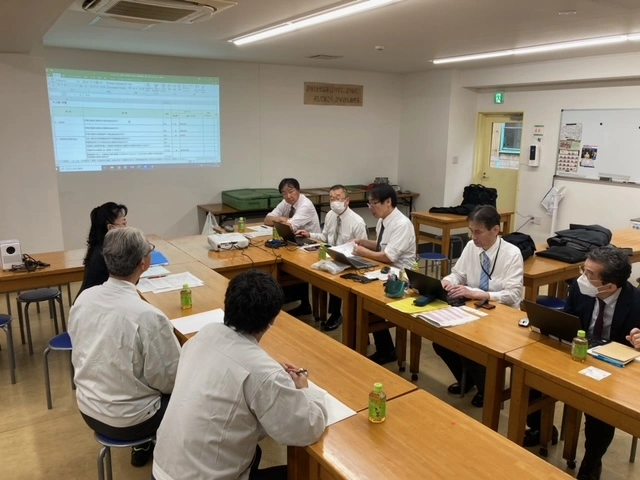
To improve the effectiveness of CSR procurement, we conduct on-site CSR audits of our business partners. In fiscal 2025, we selected 24 Rank A business partners with issues in the environmental category and conducted on-site audits. During these audits, we confirmed their understandings of the importance of CSR activities and the status of their actual activities, ensured alignment with the evaluation criteria and improvement methods, and shared issues. We are also training our own auditors to expand on-site audits; in fiscal 2025, we added 13 auditors, bringing the total to 32. In fiscal 2026, we plan to expand the number of business partners subject to on-site audits and to further increase the number of our own auditors, while strengthening direct communication with our business partners.
Contributing to Business Continuity through Stable Procurement
Initiatives for Purchasing from Multiple Suppliers to Prepare for Emergencies
We conduct risk assessments for the 200,000 parts and materials that we order on an ongoing basis and, after visualizing single-source items, are promoting multi-sourcing. In fiscal 2025, we achieved multi-sourcing for approximately 90% of our procured items (a five-percentage-point increase from the previous fiscal year). In fiscal 2026, we will target a multi-sourcing rate of 95% and aim to complete a system for purchasing from multiple suppliers.
| Risk | Definition |
|---|---|
| A (Low) | Multi-sourcing complete (ordering complete) |
| B | Multi-sourcing preparation complete (ordering possible) |
| C | Material evaluation complete |
| D | Candidate selection complete / not yet evaluated |
| E (High) | Specified customer, no alternative, discontinued, alternative unknown |
Response to Natural Disaster and Geopolitical Risks
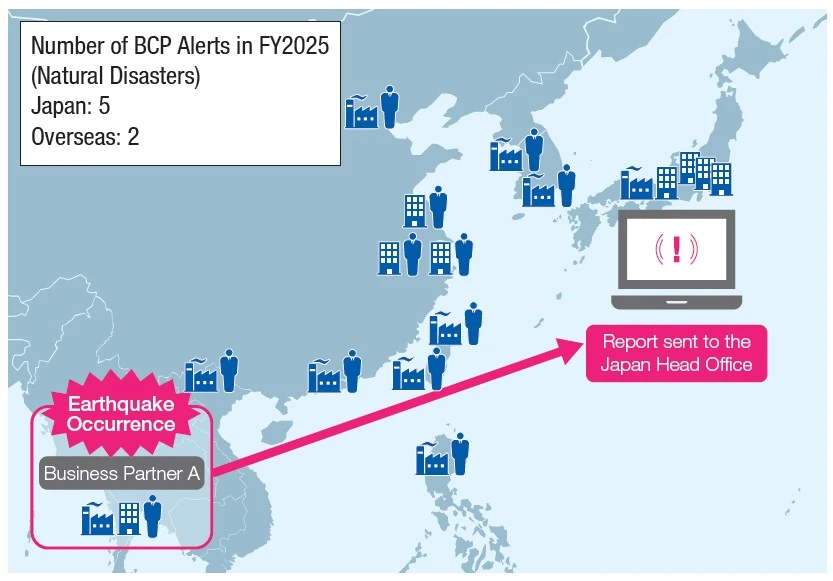
In Japan, we utilize a disaster prevention system that can identify business partners located in areas subject to special warnings for earthquakes or weather. We have established a system for quickly ascertaining whether our business partners have been affected and the impacts on our company, enabling us to promptly implement countermeasures. We have expanded the scope of registration of this Japan disaster prevention system to include secondary business partners, with approximately 13,000 sites registered in fiscal 2025.
To respond to disasters occurring overseas, we introduced a new disaster prevention system in fiscal 2025 and registered approximately 200 sites. In fiscal 2026, we will expand the scope of registration to include secondary business partners, aiming to further strengthen our global BCP, accelerate emergency response, and reinforce preventive risk measures.
Compliance with the SME Transactions Act and the Act on Promotion of Entrusted SMEs (Promotion Standards)
Each month, we rigorously monitor compliance with the SME Transactions Act*1 (effective January 1, 2026 following the amendment of the Subcontract Act), an important law governing procurement activities. Based on transaction data from our operations and those of our consolidated subsidiaries in Japan, we verify compliance in our transactions. We also provide e-learning to all employees across the consolidated Group to ensure thorough understanding of the purpose of the law and compliance with its provisions.
Aiming to build new partnerships with our business partners, we updated our Declaration of Partnership Building in January 2026. Under this declaration, we will ensure thorough compliance with the Act on the Promotion of Entrusted SMEs as well as promote fair and highly transparent transactions.
*1 SME Transactions Act: Act on the Preventing Delay in Payment to Small and Medium-Sized Entrusted Business Operators in Relation to Manufacturing Consignment.
Digital Collaboration on Procurement Information
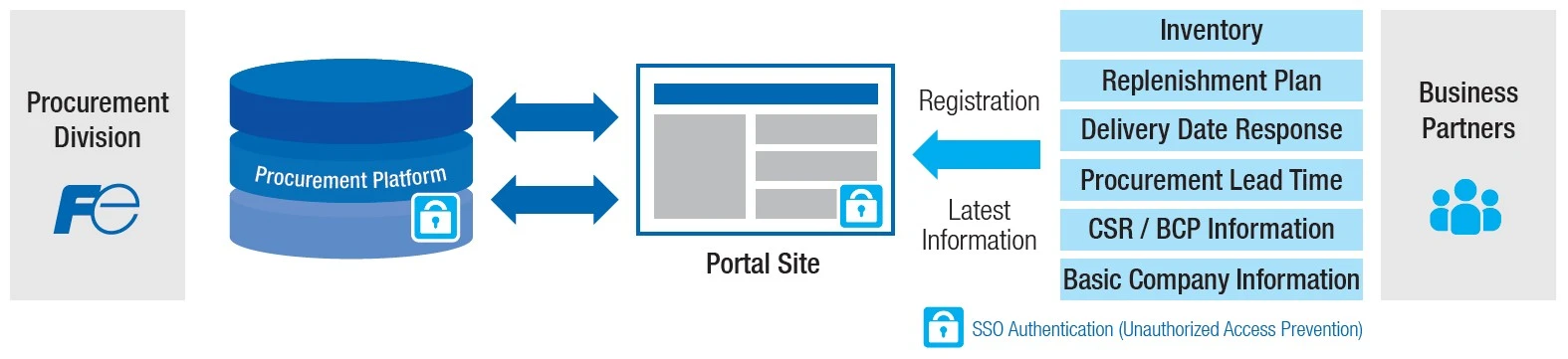
By digitally linking procurement information with that of our business partners, we aim to reduce inventory balances by shortening procurement lead times, respond flexibly to fluctuations in production volume, and achieve stable procurement that does not affect production processes while improving operational efficiency.
In fiscal 2025, we began operation with 10 major business partners. Business partners have told us that "early identification of priority items has improved operational efficiency." Going forward, we will expand the number of business partners with which we digitally link information and promote greater operational efficiency and stable procurement for both parties.