


Share





 Products & Solutions Top
Drives & Controls
UPS & Industrial Power Supply
Sensors & Measurements
Energy Management
Monitoring & Control System
Distributions & Controls
Transmission & Distribution
Transit System
Semiconductors
Energy
Food and Beverage Distribution
Service & Equipment Upgrades
Solutions
Products & Solutions Top
Drives & Controls
UPS & Industrial Power Supply
Sensors & Measurements
Energy Management
Monitoring & Control System
Distributions & Controls
Transmission & Distribution
Transit System
Semiconductors
Energy
Food and Beverage Distribution
Service & Equipment Upgrades
Solutions
Share
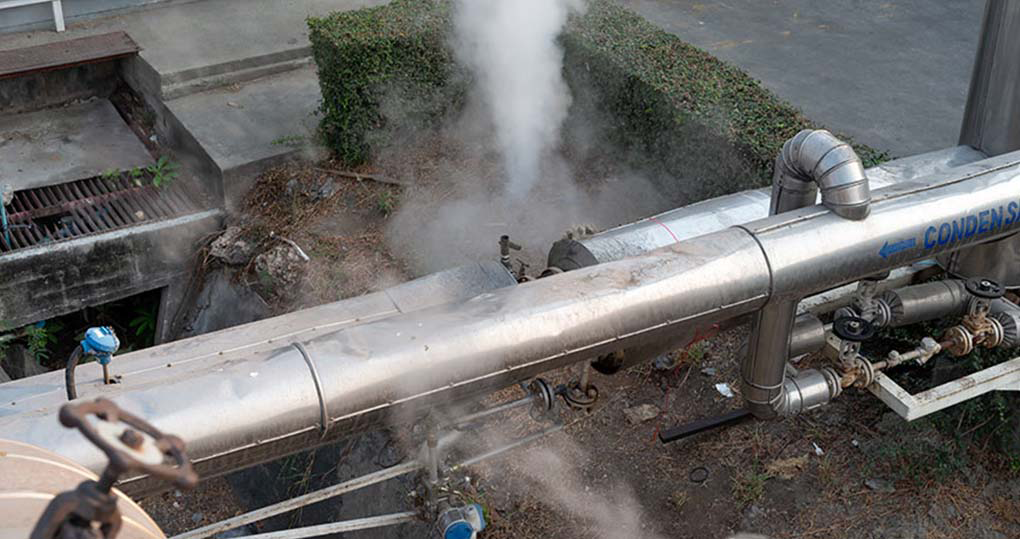
While steam energy is used in factory production lines, steam leaks may occur in piping and other components. In fact, there may be not only cases in which water droplets form around the pipes and drip down, but also cases in which steam leaks also occur in areas that are not visible to the naked eye. Steam leak results in reduction of the thermal efficiency of the entire factory facility as well as wasted fuel costs. In addition, there are many other adverse effects as well.
This section explains steam leaks focusing on their causes and countermeasures.

Even A Small Steam Leak Can Result in Loss Costs Ranging from Several Hundred Thousand Yen to Over One Million Yen per Year
Where Are Some Typical Places in A Factory Where Steam Leaks Are Likely to Occur?
Measures to Be Taken When Steam Leaks Are Discovered in Piping, Valves, and Steam Traps
Case Study of A Beverage Manufacturer That Introduced Steam Flow Meters and A Thermal EMS Solution to Detect Steam Leaks
In general, there is little concern about steam leaks from steam pipes or valves in factories that have thoroughly implemented energy-saving measures. However, continuous operation of the equipment over time can cause aging deterioration around the steam equipment, which can lead to steam leaks.
In fact, if just a small steam leak is underestimated, it can often lead to a decrease in the overall thermal efficiency in terms of energy and results in significant heat loss. For example, even a small steam leak from a single tiny hole can result in wasted costs of hundred thousand yen or more annually.
For reference, let's calculate the loss cost when a small 2 mm hole appears in a pipe.
Steam boiler fuel: city gas "13A"
Condition settings: lower heating value of 13A: 40.6 MJ/Nm3, unit price of 13A: 65 yen/Nm3, steam pressure: 0.7 MPaG (the pressure range commonly used in factories)
The loss cost per hour under this condition is 56.74 yen
In the case of a factory operating 24 hours a day, 350 days a year, the annual operating time is 8,400 hours.
Therefore, the annual loss cost = 56.74 yen/h × 8,400 hours/year = 476,616 yen/year
The above shows how the calculation works out.
Adding it all up makes it clear that there is a considerable loss cost.
In addition to the loss of thermal energy, care must also be taken from the safety standpoint, since leaving a steam leak unchecked can result in injury to workers. Steam leaks through the heat insulating material installed on the pipes, which causes hot water to drip from the joints. There is also the risk of invisible steam leak, which can cause burns when accidentally coming into contact with it. Leaving a steam leak unchecked can deteriorate the equipment around the piping, which could lead to malfunctions. Therefore, it's important to take action promptly.
By the way, where exactly are the places in a factory where steam leaks are most likely to occur? Three most common parts are considered, which include "pipe fittings", "valves", and "steam traps”.
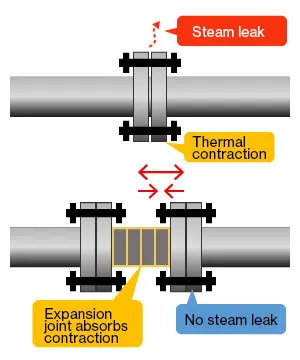
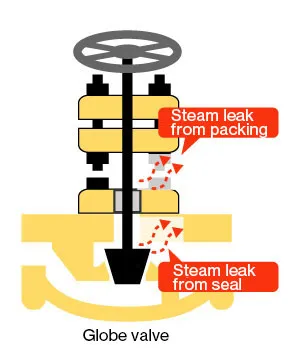
What is often seen on-site is steam leaking from the flanges, which are the joints between pipes. The main cause of this leak is deterioration of the packing. In valves, in addition to visible external leak from the packing, there can also be invisible leak from the internal seal area to the secondary side.
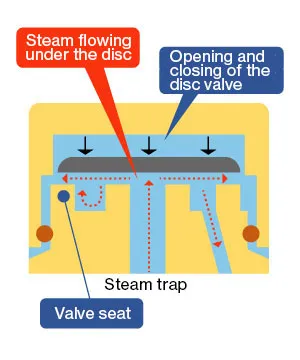
One point to be careful of is the steam leak from the steam trap. A steam trap is an automatic valve that discharges drain water (condensed water) from piping and equipment while maintaining a constant steam atmosphere. Normally, a steam trap will release high-pressure drain water and flash steam, causing white vapor to rise from the drain.
Therefore, this makes it difficult to distinguish between normal and abnormal cases. Sometimes a trap can really malfunction and cause a steam leak, but it's hard to tell just by looking at it. In order to detect this, monitor the amount of steam in the equipment, check whether the usage has increased compared to the usual, and if there is a change, suspect a malfunction.
In addition, hidden pipes in places such as the ceiling or underground are one of the most difficult areas to detect steam leaks. In order to detect steam leaks in these locations, it is necessary to establish a system to measure the flow rate daily and detect signs of changes in real time.
If a steam leak is discovered, there are a variety of ways to deal with it, ranging from first-step measures to permanent solutions. In most cases, the problem is resolved with a first-step measure, and it seems common to address problems by replacing broken parts during an annual inspection or maintenance.
What should be noted is that if the phenomenon is at the level of lightly dripping of water, it's easy to think that it's not serious. Since the actual losses are not visible, no proactive measures are taken on-site, but as shown in the steam leak calculation at the beginning, considerable loss costs have been occurring.
The following figure shows measures to prevent steam leaks from piping, valves, and steam traps.
| Steam leaks around the piping | Steam leak from the valve | Steam leak from the steam trap | |
|---|---|---|---|
 |
 |
 |
|
| Leak location | Pipe and valve connections | Leak from internal/inside the valve | Steam leak from the secondary side of trap |
| Cause | Loosening of bolts and threaded parts and deterioration of gaskets caused by the stress of thermal expansion and contraction Inside the valve: Looseness or deterioration of the gland packing | Internal side of valve: Steam leak to the secondary side caused by seal deterioration | In a saturated state, since steam and drain water coexist, steam gets entrained when drain water is discharged |
| Countermeasure | Retightening, gasket replacement, changes to the flange's fixed support points, and addition of expansion joints | External side of valve: Retightening of the screw, replacing with a bellows-type sealing valve Internal side of valve: Individually install the flow control and shut-off valves, and install a separator |
Select and install an energy-saving type trap |
Finally, let's introduce an episode about steam leak detection at a major beverage manufacturer.
Since this manufacturer produces drinking water, it has the equipment that applies pressure to raise the temperature of the beverage for sterilization. Therefore, it uses steam energy for heating, but there are many pieces of equipment operating in the factory, and the amount of steam used can vary considerably depending on the opening and closing of valves in other equipment, which leads to suspicions of a steam leak within the equipment.
Therefore, by introducing steam flow meters and the thermal EMS solution (automated heat balance analysis system) focusing on individual pieces of equipment and measuring the steam flow in each operating mode, it was possible to visualize changes in steam flow as data and understand the thermal efficiency and utilization efficiency during operation. This clarified the locations where steam losses occur, which made it possible to perform the operation with optimal heat balance.
Without performing such a large-scale investigation, it is possible to identify steam leaks simply by installing more than one steam flow meter on the line equipment or by using clamp-on steam flow meters that are easy to install and remove. Since there may be cases in which early steam leaks can be hard to notice and difficult to detect, it is important to regularly check for changes in the flow rate.

What Energy-saving Measures Can Be Implemented in Steam Equipment?
March 6,2026
Why Is Saturated Steam Important in The Industrial Sector?
March 6,2026
Reduce On-site Pressure Loss
March 6,2026
Waste Heat Recovery
March 6,2026
