


Share





 Products & Solutions Top
Drives & Controls
UPS & Industrial Power Supply
Sensors & Measurements
Energy Management
Monitoring & Control System
Distributions & Controls
Transmission & Distribution
Transit System
Semiconductors
Energy
Food and Beverage Distribution
Service & Equipment Upgrades
Solutions
Products & Solutions Top
Drives & Controls
UPS & Industrial Power Supply
Sensors & Measurements
Energy Management
Monitoring & Control System
Distributions & Controls
Transmission & Distribution
Transit System
Semiconductors
Energy
Food and Beverage Distribution
Service & Equipment Upgrades
Solutions
Share

Effective Utilization of Thermal Energy is Often Overlooked with Regard to Energy Saving!
The Benefits of Waste Heat Recovery Are Reducing The Amount of Thermal Energy and Lowering The Costs
What Is The Structure of A Heat Pump That Pumps Heat and The Mechanism of Waste Heat Recovery?
Introducing A Heat Pump into The Process of Food Processing Equipment Eliminates The Need for An Entire Boiler as A Heat Source!
Important Notes for Waste Heat Recovery: Finding High-temperature Waste Heat Is The Most Important Point!
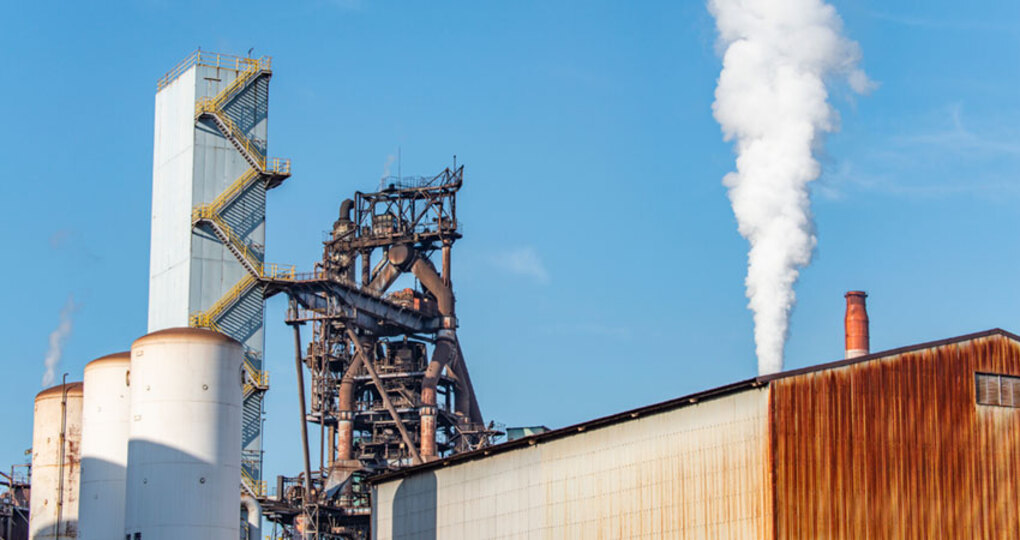
While the government has set a goal to achieve zero CO2 emissions by 2050, globally, energy-related targets have also been selected as part of the United Nations' Sustainable Development Goals (SDGs), which should be achieved by 2030.
In this way, as environmental issues have gained attention, companies have also begun to proactively promote energy-saving measures. However, energy-saving reminds many persons primarily of electrical energy.
In fact, many companies are promoting renewable energy such as solar power generation, however, with regard to thermal energy, awareness of energy conservation has not yet been widespread.
Therefore, conversely, it can be said that there is even greater potential for saving thermal energy and significant effects can be achieved.
Now, what exactly can be done to achieve energy savings in thermal energy?
One of the several applicable ways is "waste heat recovery". When manufacturing products in a factory, many processes consume and discard thermal energy. If that thermal energy is recovered and reused, it will be possible to reduce the current amount of thermal energy used. The part of the factory that generates the largest amount of waste heat is the production process. Used hot water and steam turn into warm water which is treated as "exhaust heat", and then often discarded as it is as "waste heat".
Here, the terms exhaust heat and waste heat are used separately. What is the difference between them? Exhaust heat refers to the state in which heat is released.
Therefore, it may be discarded as heat or reused. On the other hand, waste heat is the heat that is simply discarded without being used.
In the situation where heat is discarded in the factory processes, recovering it can provide significant benefits to both the company and the environment.
If it is possible to use the waste heat recovery to save the heat used throughout the entire factory, the cost of thermal energy can be reduced accordingly.
At the same time, the fuel consumption also decreases, which significantly reduces the CO2 emissions.
It allows the companies to promote an environmentally friendly image, which indicates hitting two birds with one stone.
In order to reduce the amount of steam consumption in the production processes of a factory, there are two methods, one of which is to reduce the waste heat itself and the other is to reuse the waste heat. Further on, the following description focuses on the methods to recover and reuse waste heat. By reducing the amount of steam consumption through waste heat recovery, it may even be possible to reduce the number of boilers in some cases.
Now, let's try to paint a slightly more specific picture by taking a food production line as an example. In food processing, since it is common to perform boiling and steaming, boilers are mainly used as the heat source.
● When steaming
Steam and high-temperature exhaust are released into the air through the exhaust vent. When performing thermal sterilization, high-temperature steam at 100°C or higher is used and discarded after use as drain water.
● When cleaning
Steam is used to create high-temperature water at 70°C to 80°C, which is used for cleaning. Since the hot water used for cleaning is dirty, it is often discarded into the drain rather than reused.
The waste heat that was discarded, in this way, during steaming or cleaning on the food production line can be effectively utilized by being recovered as energy using a heat exchanger.
A heat exchanger is a device that transfers or exchanges thermal energy from a higher temperature fluid to a lower temperature fluid. A heat exchanger is also used in the heat pump introduced below.
By utilizing a heat pump, which is a type of heat exchanger, it is possible to reuse waste hot water and wasted heat and dramatically reduce energy costs and CO2 emissions. Before proceeding to detailed discussions, it is necessary to provide a brief explanation of a heat pump.
A heat pump is literally a device that pumps heat. A typical fluid pump uses external energy such as electricity to pump water from a low position to a high position. While heat has the property of flowing from higher temperature to lower temperature (the second law of thermodynamics), a heat pump can also use external thermal energies to transfer heat from lower temperature to higher temperature.
The following shows the configuration of heat pump. It consists of four elements: a refrigerant (alternative chlorofluorocarbon) that carries thermal energy, a compressor that applies pressure to the refrigerant, an expansion valve that allows the refrigerant to expand, and two heat exchangers (one for absorbing heat and one for releasing heat), and the thermal energy is repeatedly circulated and transferred via the refrigerant.
![Schematic illustration and mechanism of a heat pump [heat circulation]](/about/column/detail/__icsFiles/afieldfile/2026/05/11/image_01_5.webp)
Let's follow the process for each heat transfer below (the temperature and pressure are just examples).
【1 ⇒2】
The refrigerant at 30 atmospheres and 10°C is compressed by the compressor. Gases have the property that their temperature rises when pressure is applied, and conversely, their temperature drops when pressure is reduced (Boyle-Charles' law). Here, since pressure is applied, the refrigerant rises to 100 atmospheres and 130°C.
【2 ⇒3】
In the first heat exchanger, the refrigerant at 130°C releases heat and warms waste hot water, etc. When the thermal energy is applied to the waste hot water, the temperature of the refrigerant drops to 100 atmospheres/20°C.
【3 ⇒4】
Since the pressure of refrigerant drops when it passes through an expansion valve, its temperature also drops. This time, the refrigerant is cooled to 30 atmospheres/5°C.
【4 ⇒1】
In the second heat exchanger, the refrigerant is used to cool the external chilled or hot water, and then it absorbs heat from sources such as outside air, slightly raising the refrigerant to 30 atmospheres/10°C.
Then, the same cycle continues, transferring heat from low temperature to high temperature.
In this way, a heat pump can produce thermal energy (hot water) or cooling energy (cold water) using only a fraction of the energy needed for transportation. With this as a premise, please consider the following model case:
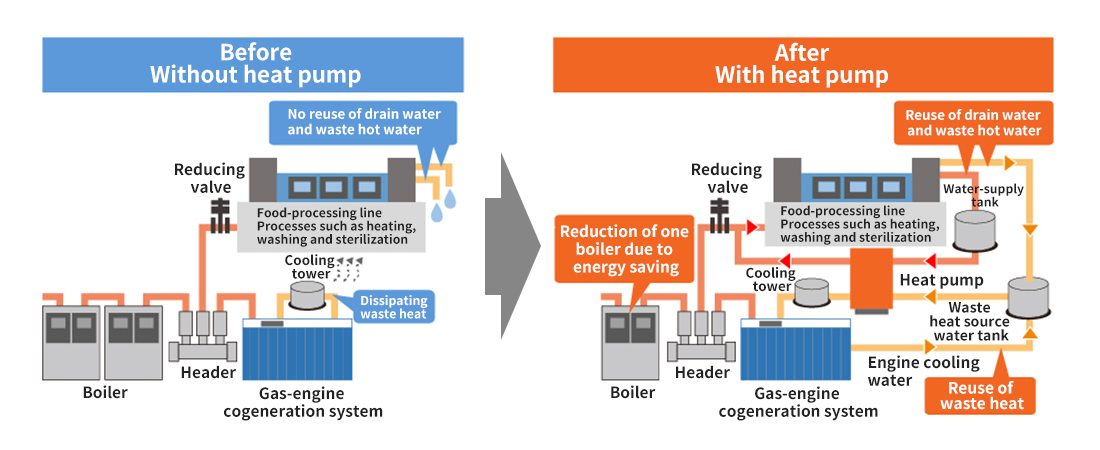
As shown in the left figure, before introducing the heat pump, drain water and waste hot water output from the food processing facility were simply discarded as they were. In addition, although electricity was generated using a gas engine cogeneration system, the exhaust heat from the engine's cooling water, which was the driving force, was not utilized either. On the other hand, as shown in the right figure, after introducing the heat pump, the drain water and waste hot water output from the food processing equipment are reheated by the heat pump and returned to the food processing line for reuse in heating, cleaning, and sterilization. In addition, the cooling water from the cogeneration system could be reused by being re-cooled with a heat pump. In this way, effectively utilizing energy through a heat pump makes it is possible to reduce the number of boilers from two to one, and has the potential to reduce both energy costs and CO2 emissions by half.
Finally, the following briefly discusses the key points and precautions to take when recovering waste heat.
When reusing the heat from waste hot water, impurities may be found in the water. If heat is recovered as it is, scale may gradually build up on the walls of the heat exchanger, which may cause it to malfunction. Therefore, it is necessary to perform regular maintenance such as inspections and cleaning in order to prevent the heat exchanger from becoming clogged with scale or experiencing a drop in performance during waste heat recovery.
When selecting a heat exchanger, it is better to choose one that minimizes the efforts as much as possible.
In addition, corrosive fluids pose a risk of damaging the equipment. Therefore, selecting the material quality for the heat exchanger is also important. It is recommended to select corrosion-resistant materials such as SUS (stainless steel) and titanium.
Although there are many precautions to keep in mind when recovering waste heat, basically, the key point is to find a location where there is high-temperature waste heat. This is because the higher the temperature and the larger the amount of emissions, the more efficiently the thermal energy can be recovered. However, it seems that waste heat is often not properly measured in places like factory sites.
Even if it appears that "waste hot water is being discharged" or "a large amount is coming out", in reality, the temperature and flow rate are rarely measured quantitatively. It is important to, at least, understand the visible conditions of waste hot water and carefully consider whether it can be used for waste heat recovery. As a first step, it would be a good idea to introduce a flow meter and begin to visualize the thermal energy.
A Thorough Guide to The Causes and Solutions for Steam Leaks
March 13,2026

What Energy-saving Measures Can Be Implemented in Steam Equipment?
March 6,2026
Why Is Saturated Steam Important in The Industrial Sector?
March 6,2026
Reduce On-site Pressure Loss
March 6,2026
