


Share





 Products & Solutions Top
Drives & Controls
UPS & Industrial Power Supply
Sensors & Measurements
Energy Management
Monitoring & Control System
Distributions & Controls
Transmission & Distribution
Transit System
Semiconductors
Energy
Food and Beverage Distribution
Service & Equipment Upgrades
Solutions
Products & Solutions Top
Drives & Controls
UPS & Industrial Power Supply
Sensors & Measurements
Energy Management
Monitoring & Control System
Distributions & Controls
Transmission & Distribution
Transit System
Semiconductors
Energy
Food and Beverage Distribution
Service & Equipment Upgrades
Solutions
Share


From Upstream to Downstream! An Explanation of Major Steam Facilities That Can Utilize The Flow of Thermal Energy
Why Are Energy-saving Measures Strongly Demanded in Steam Facilities Now?
Energy-saving Measures That Can Be Implemented in Steam Equipment - Proper Steam Supply, Heat Retention, Heat Reuse, and Steam Leakage Prevention
First, Let's Start by Accurately Understanding The Steam Flow Rate in Order to Investigate The Cause!
Steam is an indispensable energy source in a wide range of industrial sectors, including food and beverage, chemical and petroleum, paper and pulp, and steel, and is used for a wide range of purposes, including heating, humidification, sterilization, air conditioning, and powering machinery. When using steam in businesses and factories, various types of equipment are utilized. The following explains the "most basic of basics" of steam equipment from the perspective of thermal energy, as well as the energy-saving measures to use this equipment efficiently.
Now, let's take a look at the equipment needed for using steam, from upstream to downstream.
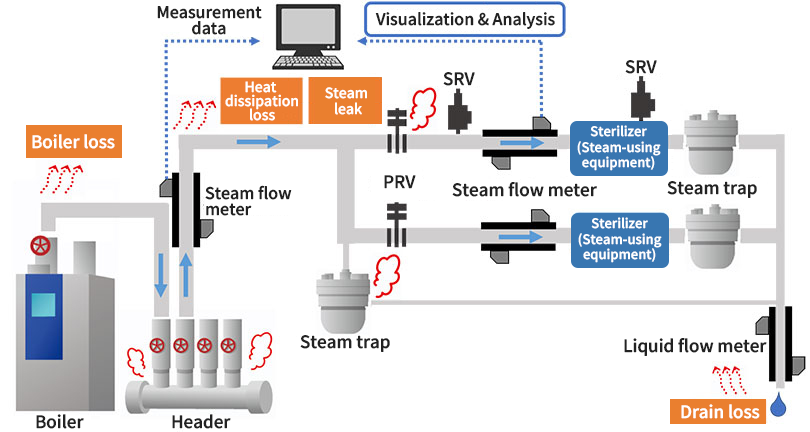
First, the steam produced by the boiler passes through the "header" and is distributed to each building through the carrier piping. In the middle of the piping, the steam may cool down and return to "drain water" (hot water), which may accumulate. Therefore, "steam traps" are placed at regular intervals to discharge the drain water from the piping.
Since the pressure of the steam that is carried close to the equipment inside the building fluctuates during this process, it is regulated to a specified pressure by a "pressure reducing valve" before entering the appropriate heating device, and stabilized at the required temperature. In addition, a "safety valve" is also installed to allow steam to be released at any time in case the pressure inside the pipes or equipment becomes abnormally high due to a malfunction or other reasons.
The previously mentioned steam trap may also be installed near "areas where steam is used, such as sterilizers", as shown in the diagram above. While the heat exchanger, which handles the transfer of thermal energy, is filled with steam, but at the same time, since drain water tends to accumulate at the bottom, a steam trap is installed on the outlet side to discharge the water and let it flow into a drain channel.
While steam equipment is used in many offices and factories, from the perspective of efficient energy utilization, there has been a growing demand particularly for energy-saving measures. This is because, in order to promote high-quality manufacturing with high productivity, there is a desire to use steam heat without waste.
Moreover, recently there has been a growing societal demand for energy-saving. For example, the Act on the Rational Use of Energy was revised in 2018. For this reason, many companies are actively promoting energy-saving measures. While energy-saving measures related to electricity, which are easier to implement, are being carried out first, in the future, energy-saving measures for heat, which consumes more energy than electricity, are likely to be more emphasized.
Incidentally, in terms of the Sustainable Development Goals (SDGs), Japan has set a medium-term goal of reducing greenhouse gas emissions by 26% by 2030 compared to fiscal 2013 levels. (https://www.env.go.jp/council/01chuo/y010-24b/mat03_3_1.pdf (Japan site)) In that regard as well, improving energy-saving in thermal energy has become extremely important.
Therefore, specifically, what points should be paid attention to in order to advance energy-saving measures for steam equipment?
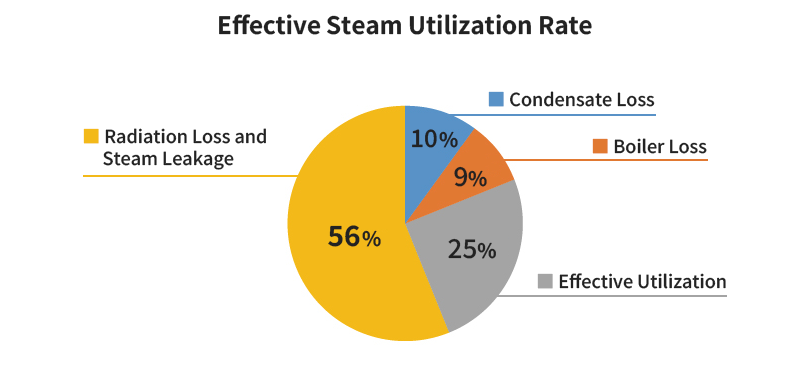
It is necessary to pay attention to "where losses are actually occurring in the steam equipment". For example, it is said that in the total heat losses of a typical steam line, combustion losses in the boiler occupy approximately 9%, heat losses and steam leakage in the piping occupy approximately 25%, and losses due to the drain water occupy approximately 10%. (Source: Fuji Electric Journal 2020, Page 12, No. 1, Vol. 93) Since a total of 44% of heat is not used effectively, if this can be improved, energy savings should increase considerably.
In the steam lines with the greatest losses, it is important to optimize the piping routes to prevent unnecessary heat dissipation. If the piping is routed over a long distance, measures such as moving the heat source (boiler) closer should be taken during renovations. It is also important to perform the control by frequently stabilizing the steam pressure using a pressure reducing valve.
In addition, there may be a case in which steam is leaking from pipe joints or old steam traps. Such leaks are usually hard to notice and difficult to detect. Therefore, visualizing the steam flow rate and identifying the leak points are the key to energy-saving measures.
In addition, to prevent heat loss in areas other than the piping, it is necessary to implement measures by introducing easily attachable thermal insulation jackets. Depending on the location of use, several types of jackets are prepared, including "for global valves", "for Y strainers", "for pressure reducing valves", and "for flanges".
The next largest source of loss is the drain water. From the perspective of thermal efficiency, it is important not only to completely discharge the drain water, but also to reuse it as heat for high-pressure hot water. The unused heat is reused after the drain water is separated from the flash steam by a separator. At that time, using it as a heat source for the heat pump could also be an option.
In addition, it is also important to provide measures for preventing losses on the boiler side. It is necessary to improve the combustion efficiency and ensure the proper steam supply so that the boiler can generate only the required additional steam. To achieve this, it is necessary to prevent excessive supply by controlling the number of boilers in operation while understanding their usage efficiency.
So far, the above has explained the energy-saving measures that can be implemented on steam equipment. While there are various measures that can be taken, the most important point is the "visualization" that enables to understand the state of the steam flow rate. This is because if it is not possible to identify where the thermal energy of the steam is being wasted and the cause of the loss, it may not be possible to take appropriate measures.
Therefore, on-site, flow meters for measuring steam flow rate play very important roles. However, since there are various measurement methods for steam flow meters, it may be unclear which one to choose.
For example, while popular types of steam flow meters include the "differential pressure type" and the "vortex type", recently, the "ultrasonic type" has also been attracting attention as the third option. The reason is that the conventional methods cannot measure low flow rates, which makes it difficult to detect minor steam leaks. With regard to this point, ultrasonic types can be used to measure across the entire range without any dead zones.
In addition, ultrasonic systems also have advantages in terms of operation. With the traditional methods, it is necessary to install a flow meter inside the pipe, which makes the construction difficult. Even if the device broke down, it couldn’t be replaced immediately, and it was necessary to wait until the next renovation. Since some ultrasonic flow meters can be easily attached to external piping using a clamp-on system, the need for construction work is eliminated and the measurement location can also be easily changed.
If you would like to learn more about clamp-on ultrasonic flow meters, please read this article for a more detailed understanding.
A Thorough Guide to The Causes and Solutions for Steam Leaks
March 13,2026
Why Is Saturated Steam Important in The Industrial Sector?
March 6,2026
Reduce On-site Pressure Loss
March 6,2026
Waste Heat Recovery
March 6,2026
