


Share





 Products & Solutions Top
Drives & Controls
UPS & Industrial Power Supply
Sensors & Measurements
Energy Management
Monitoring & Control System
Distributions & Controls
Transmission & Distribution
Transit System
Semiconductors
Energy
Food and Beverage Distribution
Service & Equipment Upgrades
Solutions
Products & Solutions Top
Drives & Controls
UPS & Industrial Power Supply
Sensors & Measurements
Energy Management
Monitoring & Control System
Distributions & Controls
Transmission & Distribution
Transit System
Semiconductors
Energy
Food and Beverage Distribution
Service & Equipment Upgrades
Solutions
Share


What Is Saturated Steam Used in The Industrial Sector? What Is The Difference from Superheated Steam?
Why Is Saturated Steam Important in Factories and Facilities? What Is The Main Reason?
Three Key Points for Effectively Using Saturated Steam in The Industrial Field
What Are The Main Methods of Flow Meters Used in Steam Measurement?
While steam is a familiar and indispensable part of our daily lives, it is also widely used in the industrial sector as an unsung hero supporting various operations. For example, it plays a very important role on-site in the food and beverage industry, chemical and petroleum industry, paper and pulp industry, steel industry, etc.
Steam can be classified into "saturated steam" and "superheated steam" depending on its state. First, let's make sure to understand this difference.
Saturated steam indicates the state of equilibrium between the water and steam which is produced by heating water under constant pressure. In other words, to put it very simply, it is "the steam obtained by boiling water". Saturated steam contains a small amount of fine mist (water droplets). For this reason, it is called "wet steam" and is a common type often used for heating and humidification purposes. "Dry steam" is the type of steam created by reheating this wet steam in a boiler to evaporate the mist from it.
Superheated steam is the type of steam produced by further heating saturated steam to a temperature higher than its boiling point, and is utilized as a power source for turbines and other machinery. From this point on, the following does not discuss superheated steam, but instead focuses on the uses of saturated steam.
For example, in the food and beverage industries, the saturated steam is mainly used for the following purposes:
In this way, saturated steam has become indispensable in various production processes such as heating, drying, steaming/humidification, burning, concentration, distillation, sterilization/disinfection, and cleaning.
Then, why is saturated steam so highly valued in the industrial sector? The reason is that when things are heated with the heat of steam, since the heat is applied quickly and evenly, the quality and productivity are improved. This allows for uniform processing and sterilization.
Another reason why saturated steam is utilized in the industry is that it is easy to control the temperature and pressure. Since once the temperature is determined, the pressure is also determined, and vice versa, it is easy to achieve the desired pressure or temperature by adjusting the temperature and pressure.
Furthermore, using water makes it possible to keep the costs lower and it also has the advantage of being safe. Since steam has a higher heat transfer coefficient than the liquid state (water), it is possible to reduce the heat transfer surface area when increasing the heat. As a result, investments in the facilities can also be kept down.
Saturated steam has many advantages including the following three key points:
Steam supply at the appropriate pressure
High-quality steam supply
Measurement of steam flow rate
It is necessary to understand the above three points to utilize the steam effectively in the industrial sector.
The first point, as mentioned in the previous section, is that it is important to efficiently control and supply steam under the appropriate conditions (temperature and pressure) to various devices that use steam. For example, in order to maintain a constant temperature, it is necessary to use a device called a "pressure reducing valve" to keep the pressure of fluctuating saturated steam constant.
Additionally, regarding the second point, it is required to supply high-quality steam in order to prevent problems such as equipment damage, vibration, and noise. When saturated steam cools down, it turns back into hot water (called "drain water"), but if it remains in the equipment such as piping or heat exchangers, it can interfere with heating or cause a phenomenon known as "water hammer", which can pose a risk of damaging the equipment. Therefore, it is necessary to properly drain the drain water.
The third point is related to the accuracy of flow measurement, measurement range, ease of installation, and maintainability. Flow measurement is also important from the perspective of energy saving. It is necessary to understand the state of the steam and take action if a leak from a pipe or other source is found.
In terms of operation, until now, since it was necessary for installing a steam flow meter to cut the piping and temporarily shutting down the equipment, it was usually installed during equipment upgrades or modifications. Therefore, there is a need for a mechanism that allows flow meters to be easily installed at any time.
Among the three points mentioned earlier, the particularly important point is the measurement of steam flow rate. If it is possible to "visualize" the state of the steam flow rate, it can lead to energy savings and cost reductions. That’s why a device called the "steam flow meter" is used to measure the flow rate of steam.
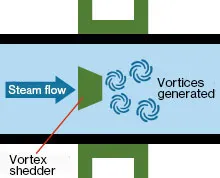
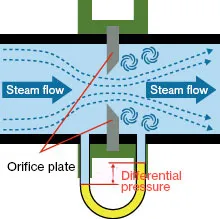
While there are a number of types of steam flow meters, they can be broadly classified into "ultrasonic", "vortex", and "differential pressure" types, according to their main measurement methods.
| Method | Ultrasonic type (clamp-on) | Vortex type | Orifice type (differential pressure) |
| Types of measurement | 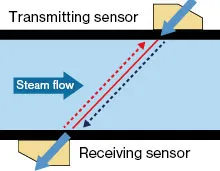 |
 |
 |
| Piping work | ○ Not required | × Required | × Required |
| Accuracy | △ ±3 to 5% rdg. | ◎ ±1 to 2% rdg. | ○ ±2% rdg. |
| Pressure loss | ○ No | × Yes | × Yes |
| Minimum flow rate | ○ Measurement is possible from zero flow rate (With no dead zone) |
× Limit is applied to the minimum flow rate (With dead zone) |
× Limit is applied to the minimum flow rate (With dead zone) |
| Range ability | ◎ 2-range switching function is available | ▲ Wide | × Narrow |
Note
The parts in bold indicate weak points
The methods most commonly used for steam measurement are the "differential pressure type" and "vortex type". The differential pressure type measures the flow rate by inserting a throttle valve called an 'orifice type' into the pipeline through which steam passes, and measuring the pressure difference between before and after the throttle valve. The vortex type also calculates the flow rate by measuring the state (frequency) of vortices (called "Karman vortices") generated within the pipeline. The ultrasonic type transmits ultrasonic waves through the steam flowing in the pipeline, and calculates the flow rate based on the difference in the propagation times between the forward and reverse directions.
Since each of these measurement methods has its own advantages and disadvantages, it is important to choose a flow meter that is suitable for the company's products and equipment. For example, although the differential pressure and vortex types have relatively good measurement accuracy, because they measure the flow by coming into contact with the steam in the pipeline, they still have issues such as pressure loss during measurement and difficulty in measuring in the low speed range (occurrence of dead zones). From an operational perspective, installing the flow meter in the piping requires time and effort for both installation and maintenance.
On the other hand, the ultrasonic method is a non-contact measurement method that propagates ultrasonic waves. In particular, the clamp-on type is easy to install because it can be used by simply clamping it on a pipe from outside. Above all, since it measures steam without direct contact, it has the advantage that there is no pressure loss and measurement can be performed even from the state when the flow rate is zero (with no dead zones). In addition, since it is a clamp-on type, it is not necessary to stop the equipment even during maintenance. Although the measurement accuracy is slightly lower than that of the differential pressure or vortex types, it can be said that for steam measurement, an error within the range of ±3% to 5% is generally considered to have no significant impact. Rather, the key point of ultrasonic flow meter is that it has no dead zones and can accurately measure flow rates at low speeds.
Ultrasonic flow meters serve as an excellent third option for understanding the condition of fluid flow. For readers who want to know more details, reading this article will promote a better understanding.
A Thorough Guide to The Causes and Solutions for Steam Leaks
March 13,2026

What Energy-saving Measures Can Be Implemented in Steam Equipment?
March 6,2026
Reduce On-site Pressure Loss
March 6,2026

Waste Heat Recovery
March 6,2026
