

Share





 Products & Solutions Top
Drives & Controls
UPS & Industrial Power Supply
Sensors & Measurements
Energy Management
Monitoring & Control System
Distributions & Controls
Transmission & Distribution
Transit System
Semiconductors
Energy
Food and Beverage Distribution
Service & Equipment Upgrades
Solutions
Ensuring Product Security
Products & Solutions Top
Drives & Controls
UPS & Industrial Power Supply
Sensors & Measurements
Energy Management
Monitoring & Control System
Distributions & Controls
Transmission & Distribution
Transit System
Semiconductors
Energy
Food and Beverage Distribution
Service & Equipment Upgrades
Solutions
Ensuring Product Security
Share
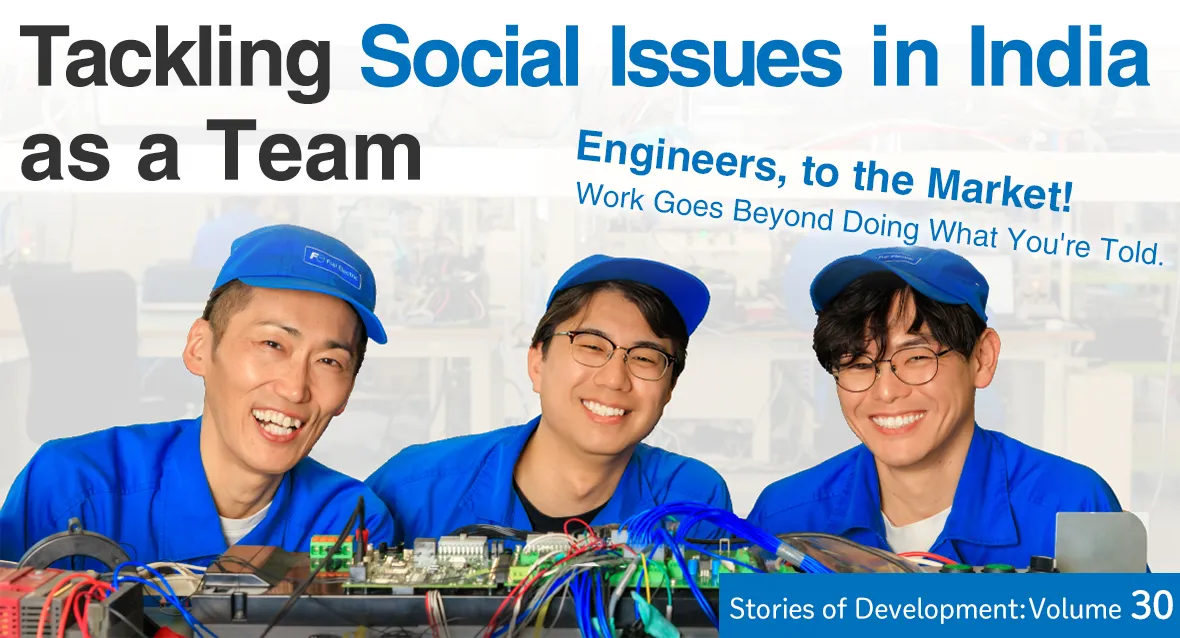
In India, power outages frequently cause elevators to stop suddenly. This has become a social problem because it often results in accidents and injuries. In order to solve this problem, Fuji Electric's development team took on the challenge of creating a product that no one ever thought of before. Engineers took to the ground themselves, reflected customer feedback into the design, and overcame barriers through the exceptional teamwork of more than 30 people.
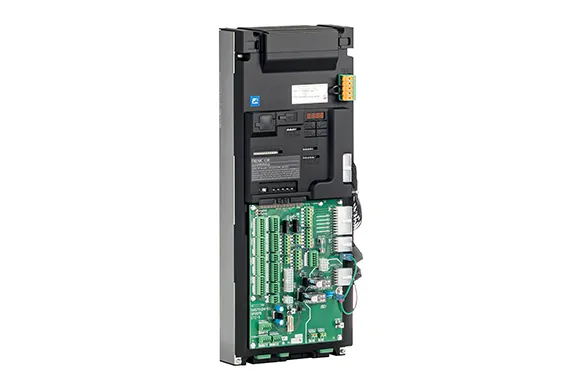
The project for developing the new product consisted of a series of unprecedented events, both in terms of collaboration with internal and external parties and with regard to verification methods.
What they developed was the integrated Smart Lift Drive FRENIC-Lift (ALL in ONE type) that integrates an inverter, controller, and uninterruptible power system (UPS) that provides backup power from a battery at times of power outages.
Fuji Electric's inverter business has historically had a strong presence, and it holds a top share in the Japanese low-voltage inverter market. It has also established a foothold in overseas markets such as China and India for its elevator inverters.
However, things have gotten a little shaky in recent years.
This is because China is now manufacturing inverters domestically. Chinese products have gained popularity in India because they integrate an inverter and controller into a single product. Fuji Electric has traditionally held a market share of about 20% in India, but this has slowly eroded since 2022. Sales offices have been complaining that "orders in India are decreasing," and this has created a growing sense of crisis within the company.
Offering similar products as Chinese manufacturers is to no avail, since it is very difficult to beat the Chinese in a cost competition. The only solution is to offer value-added products that differentiate themselves from competitors. After countless discussions in the field from a bottom-up perspective, Fuji Electric's engineers came up with the idea of developing the integrated Smart Lift Drive FRENIC-Lift (ALL in ONE type).
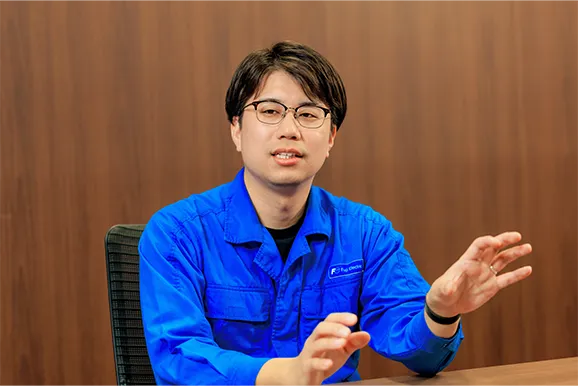
After conceiving the idea in March 2023, Mr. Ohara strengthened his resolve and told his boss, "I'll do the local marketing. How about we go together?"
But why send an engineer instead of a salesman?
Mr. Ohara remarked, "There are some tasks that require an engineer's perspective. For example, engineers can discuss things together immediately to try to solve customer problems. Engineers also have a good intuition for sensing the job requirements, and this helps facilitate the development process."
Mr. Ohara and his colleagues visited six or seven elevator manufacturers and carefully asked them questions while referring to a list of questions that needed to be answered. They diligently listened to the concerns of the elevator manufacturers, drew wiring diagrams on whiteboards, and proposed countermeasures on the spot, making suggestions such as "Wouldn't it be better to connect it like this?" The elevator manufacturers were delighted and responded by saying, "That's intriguing!" or "How interesting!"
As they listened, something came into view. They realized that power outages are quite frequent in India and that accidents and injuries in elevators due to sudden stoppages have become a social problem in India. Only some high-rise buildings and large hospitals have high-performance power systems that keep elevators running normally during power outages. Typical building owners cannot afford these types of power systems. Even more challenging was the fact that many buildings lack machine rooms, and elevator control panels are installed in the boarding area, requiring them to be very thin.
As a result of the visit, Mr. Ohara became convinced that the new product needed to be compact and designed particularly with the aim of protecting passengers during power outages. It would also need to be offered at a price that was comparable with existing Chinese products. He felt strongly that it would be necessary to bring this product to market as quickly as possible.
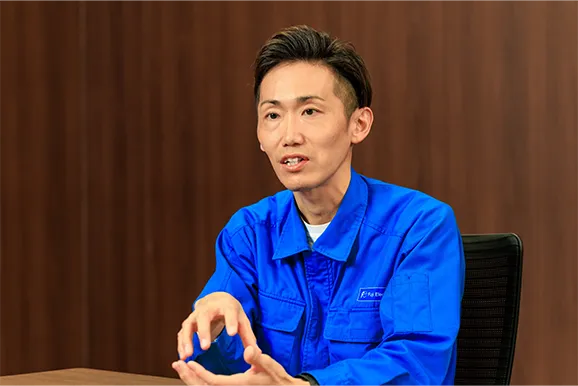
The integrated Smart Lift Drive FRENIC-Lift (ALL in ONE type) would be an unprecedented product that required rapid development. Mr. Nakato, who had been with the company for 22 years, was appointed the project leader.
He had experience leading a team in the development of another FRENIC-Lift product. However, this time was different. Mr. Nakato said, "The sheer number of developers involved was remarkable. I really got the feeling that the company was putting all their effort into this."
Usually it takes about 10 to 15 people to develop a product, but this time more than 30 people were involved. Moreover, it involved people from departments he had never worked with before. The project required three teams focused solely on software, as well as teams for hardware structure design, electrical design and UPS development.
Also, this project gave Fuji Electric's development team a new perspective as they got to work first hand with elevator manufacturers.
Inverter manufacturers had presumed that dangerous situations can be averted by just stopping the elevator. However, simply stopping the elevator leaves people trapped inside it. Systems used in elevators need to be considered from the perspective of safety. This realization was gained by humbly incorporating the opinions of outside engineers.
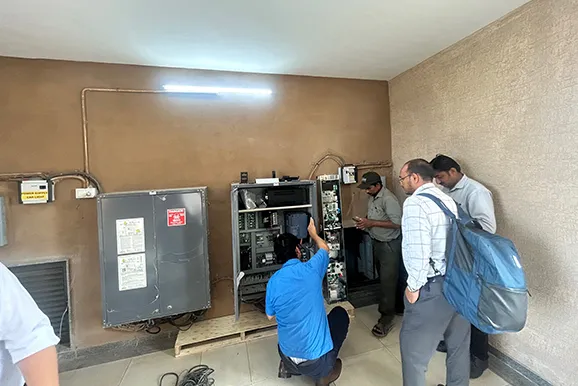
It might be thought that the more people involved, the faster the development — however, in this case things turned out differently.
Mr. Nakato shared his reflections on the project. "Naturally, problems arise during the development phase of products. However, with so many departments involved, it became difficult dealing with problems. In particular, it was hard determining the boundaries of responsibility, and there was a natural tendency for departments to get defensive and try to pass the ball of responsibility onto others. It was like playing on a baseball team with one blooper after another."
The inverter, controller, and UPS all operated normally as standalone products, but abnormalities occurred the moment they were integrated together as a single product. In response, Mr. Nakato held "problem-solving meetings." These meetings were held 2-3 times a week to thoroughly discuss the progress of the project and quickly decide who would handle what and how.
The development site was the Suzuka Factory in Mie Prefecture. Mr. Nakato also requested that development members from the Tokyo Factory be permanently stationed at the Suzuka Factory during the development period.
"It is not possible to grasp problems in real time while working at a remote location. Also, we wouldn't be able to meet our deadline if we were limited to discussing problems at a weekly meeting. It was hard asking people to leave their families, but I was encouraged that everyone was willing to do what it takes to get the project done."
As the leader, Mr. Nakato was conscious of everyone's commitment and encouraged them to think independently about what they could do to help progress the work.
The results were immediate. Mr. Nakato said, "It wasn't necessary to tell them what to do. Instead, everyone took the initiative to think about what they could do individually to solve our problems. I think this was because everyone took the perspective that the new product development was their own."
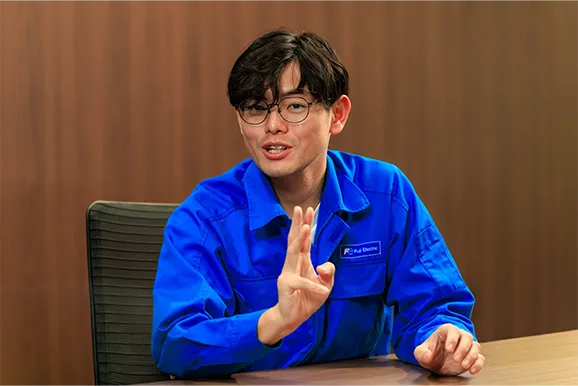
In January 2024, Mr. Myojo, who was in charge of equipment verification, received a prototype of the new product. Mr. Myojo remembers thinking, "How exactly does this thing work?"
In normal development projects, products only arrive at the verification department after they have been completed to a certain extent. Products can only be shipped after they have passed a series of specified test items. However, this product could not be approached the same way.
Mr. Myojo shared his experienced, saying, "Since it was a one-of-a-kind product that no one ever saw before, I didn't have a point of reference for evaluating it." This meant that it would need to be repeatedly evaluated throughout the prototype development process in order to overcome problems and pass the verification. This involved a lot of fumbling around.
Mr. Myojo was afraid that nobody really had a complete overall picture of the product. It would be difficult for the product to come together as a whole if departments were only approaching it from the perspective of their own specialized fields. With this awareness, Mr. Myojo requested to participate in the problem-solving meetings with the developers.
"I felt that getting a bird's-eye view of the whole project would make it easier for us as we moved forward with the verification process. Whenever I had a question, I would go directly to the relevant department to get the answer so that we could organize the issues we needed to solve together. It was only by doing this that I gained a point of reference on the product to evaluate it."
By persistently following up with the departments on every small detail of the verification process, Mr. Nakato helped lead the project, which at times seemed to be in disarray, to a major breakthrough.
In April 2024, the team completed the prototype.
Mr. Ohara, who repeatedly visited India to hold discussions with the elevator manufacturers, said, "Riding comfort is important, but our top priority must be preventing injuries during a power outage." By limiting the specifications of existing inverters and UPSs to only those that were needed, it became possible to develop a compact, cost-efficient product.
Mr. Ohara observed the first time the prototype was installed in an elevator for demonstration testing. He planned to visit India with the demonstration test data and accompanying video footage. However, a problem arose as he was preparing to go. He was struggling with how exactly he was going to convey the features of the new product.
At that time, it just so happened that Mr. Nakato and Mr. Ohara, who both worked in the Components Development Department, visited a discount shop. As they walked around the store, they looked at various things and even tried to get some figures to stand upright on the floor. Eventually, they bought a kendama toy and left the store.
This is when Mr. Ohara realized that he wanted to show the steadiness of the new product visually instead of just using numerical data. To do this, he decided to hang the kendama ball inside the elevator car using a rubber string and then causing a power outage with the ball suspended in the air. The effect should be immediately apparent from the difference in the width of the ball's movement when the elevator comes to a sudden stop.
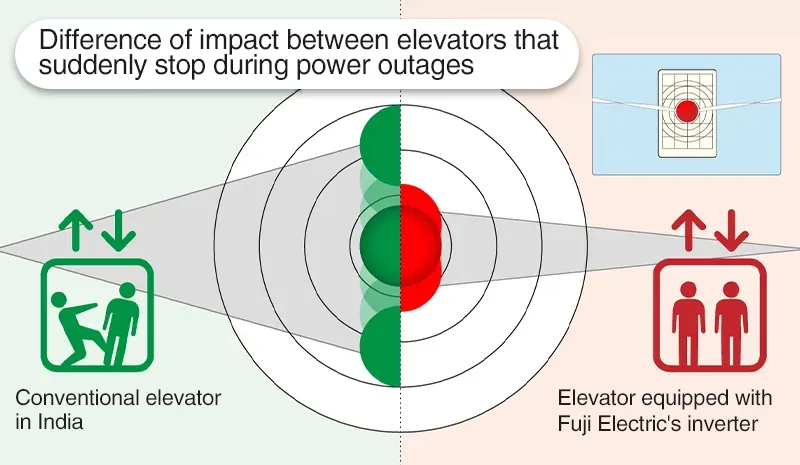
The test would involve filming the movement of the ball inside a conventional elevator in India and one equipped with the new product, and then comparing the video footage side-by-side.
When the representatives of the Indian manufacturers saw the video, they expressed their pleasant surprise by saying, "Wow!" By comparing the widths of movement, the effect of the new product was obvious to everyone.
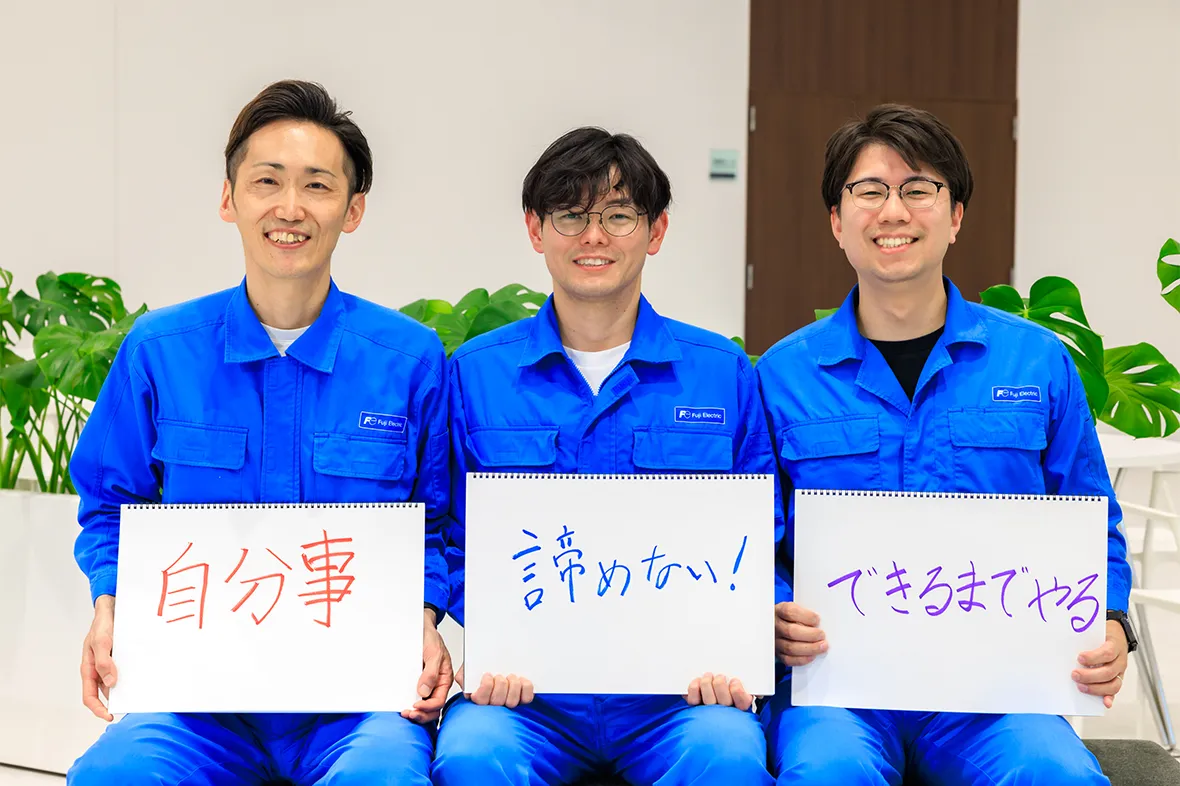
Fuji Electric's three engineers share a message with students.
Mr. Nakato (on the left) said, "Development projects involve both problems and achievements. You can become successful if you learn how to make both the problems and achievements your own." Mr. Myojo (in the middle) said, "Never be satisfied with leaving a problem unsolved. Don't compromise, but always work with the intent of seeing things through until completion." Mr. Ohara (on the right) said, "If you only consider the risks and the reasons for not doing something, you'll never be able to do anything at all. If you keep pushing ahead, things will eventually start to take shape."
Mr. Ohara said that this development project made him realize something.
"Traditionally, engineers have been responsible for ensuring that products meet their required specifications. However, this was an unprecedented product, so we were able to actually get involved in creating the specifications. As an engineer, this allowed me to think about the appropriateness of the specifications and discover some new things."
Engineers listen to the opinions of people directly on-site. The goal is to create an environment where brilliant people can pursue greater possibilities. This allows them to foster a sense of responsibility as engineers that goes beyond their immediate field of expertise. It is because of endeavors like these that new products are born.
The integrated Smart Lift Drive FRENIC-Lift (ALL in ONE type) has gained the trust of the market and is currently being ordered by local manufacturers in India. Moreover, its reputation has spread to other areas, such as Taiwan and Vietnam, and its sales channels are expanding. A new product series will soon be shipping to India.
May 21,2026
October 31,2025
July 2,2025
October 31,2024