





Sustainability
Promoting CSR Activities with Suppliers
-

Philosophy concerning Promoting Sustainable Procurement in the Supply Chain
-
Initiatives for Achieving Sustainable Procurement with Our Suppliers
-
Support for Raising Awareness among Suppliers
-
Response to Conflict Minerals
-
Rejecting Any and All Ties with Antisocial Forces
-
Occupational Health and Safety in On-Site Construction Work
Philosophy concerning Promoting Sustainable Procurement in the Supply Chain
The Fuji Electric Code of Conduct stipulates that we “Respect and value our business partners,” and we believe it is important to be a company with high social value by building a supply chain that supports a sustainable society.
One of the commitments under Fuji Electric’s Environmental Vision 2050 is to “realize a recycling-oriented society.” From the perspective of global environmental protection, we actively promote green procurement by sourcing materials with low environmental impact from suppliers who actively engage in environmental protection activities.
Initiatives for Achieving Sustainable Procurement with Our Suppliers
We are expanding “Fuji Electric’s CSR Procurement Guidelines” globally, while also aiming to build responsible supply chains with our suppliers in Japan and abroad. These Guidelines were formulated for the purpose of sharing our concept of CSR with our suppliers and having them put it into practice.
We ask our suppliers to conduct the self-assessment of CSR procurement in accordance with the Fuji Electric CSR Procurement Guidelines. This self-assessment helps us see a clear picture of CSR initiatives in our supply chain. Furthermore, in providing their answers to the questions in the assessment, our suppliers gain a better understanding of Fuji Electric’s CSR philosophy and what we would like them to comply with and practice. If any supplier seems to need more efforts in terms of CSR, we work with them so that they will achieve a higher level of CSR, thereby reducing risks involved in CSR in a supply chain. Since October 2022, we require new suppliers to conduct a CSR self-assessment to understand and evaluate the status of their CSR efforts.
Fuji Electric’s CSR Procurement Guidelines
From the perspective of reducing CSR risks in the supply chain, we established the "Fuji Electric CSR Procurement Guidelines" as a summary of the approach and specific examples of initiatives that we would like our suppliers to observe and put into practice. In formulating the guidelines, we referred to the code of conduct of the Responsible Business Alliance (RBA), a corporate alliance that promotes CSR in global supply chains, and the "Responsible Business Conduct Guidelines" of the Japan Electronics and Information Technology Industries Association (JEITA).
Fuji Electric's Green Procurement Guideline
In promoting green procurement, we established our Green Procurement Guideline and confirmed the following two points with our suppliers.
-
1.
Management status of chemical substances contained in products
-
2.
Status of chemical substances contained in delivered materials
To properly manage chemical substances across the entire supply chain, we ask our suppliers to cooperate in surveys of chemical substances contained in products through these Green Procurement Guidelines. Furthermore, to facilitate smooth surveys of contained substances, we recommend management based on the "Guidelines for the Management of Chemical Substances in Products" defined by JAMP-chemSHERPA, and ask suppliers to adopt "chemSHERPA"* as a common management tool.
-
*
-
chemSHERPA is a support tool recommended by the Ministry of Economy, Trade and Industry (METI) that integrates JAMP and the former Japan Green Procurement Survey Standardization Initiative (JGPSSI) to manage and communicate information on chemical substance content throughout entire supply chains (from upstream to downstream), including those of trading companies, for each product.
<FY2024 updates>
-
1.
Added “Country-Specific Prohibited Substances” to our controlled substances list.
-
2.
Added a “Survey Sheet on France’s Packaging Materials Mineral Oil Ink Restrictions” to the required documents/data list.
-
3.
Added “Reporting on Country-Specific Prohibited Substances” to the product chemical content survey.
Fuji Electric's Carbon Footprint Procurement Guidelines
To help achieve carbon neutrality under our Environmental Vision 2050, we created guidelines that ask our suppliers to cooperate on carbon footprint (CFP) initiatives, to help them understand our decarbonization efforts and from the perspective of visualizing greenhouse gas (GHG) emissions generated by business activities.
Based on the Fuji Electric Corporate Code of Conduct, Basic Policies on Environmental Protection, and Fuji Electric Procurement Policy, and with reference to the "Carbon Footprint Guidelines" issued by Japan's METI and MOE (March 2023), this guideline outlines the cooperation requests regarding CFP that we ask suppliers to undertake, along with specific practical steps and examples.
Support for Raising Awareness among Suppliers
We evaluate and analyze suppliers' sustainability initiatives for the purpose of engagement with suppliers and risk management. In fiscal 2025, among approximately 6,500 suppliers across the entire Group, we requested cooperation from 893 key suppliers (757 in Japan and 136 overseas) accounting for the top 80% of purchase performance over the past three years (fiscal 2022-2024). Based on the "Fuji Electric CSR Procurement Guidelines," they conducted self-assessments on the following items:
-
Human rights and labor
-
Occupational health and safety
-
Environment
-
Fair business practices
-
Quality and product safety
-
Information security
-
Business continuity planning (BCP), etc.
As a result of the survey, for 12 suppliers judged to require improvement, we held individual interviews to deepen their understanding of CSR and confirm improvement progress. In addition, since October 2022, we have made it mandatory for new suppliers to conduct a CSR self-assessment, performing comprehensive evaluations that include their CSR initiatives. Going forward, we will deepen communication with suppliers and work together to build a supply chain that supports a sustainable society.
CSR Procurement Audits: current status
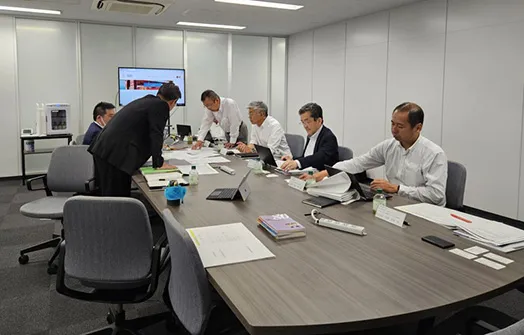
In fiscal 2025, we visited 24 suppliers and conducted on-site audits, confirming that actual conditions aligned with assessment response contents for all companies.
For fiscal 2026, we plan on-site audits for 36 suppliers.
Through on-site audits, we engage in communication with suppliers and advance two-way improvement activities that complement each other.
Training On-Site CSR Auditors
To expand on-site audits of suppliers, we are actively developing internal on-site auditors.
In fiscal 2024, 12 auditors were newly certified. Furthermore, in fiscal 2025, 13 additional auditors were certified. This brought the total number of auditors to 32 (including the secretariat), making it possible to conduct audits with a two-person team per site, establishing a more effective and efficient audit system.
<Auditor certification process>
・Complete training in on-site audits
Communication with Business Partners
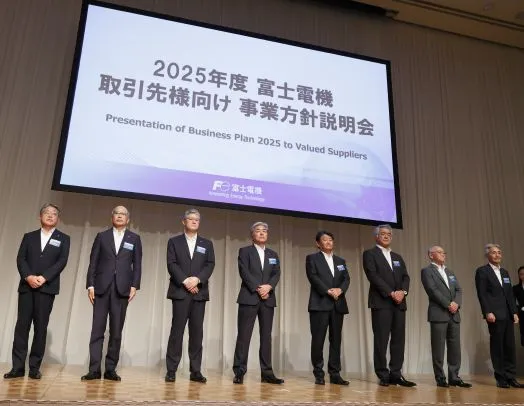
Once a year, Fuji Electric invites suppliers who have made significant contributions to our business to attend a "business policy explanation meeting." Based on the recognition that it is our suppliers who support our production activities, we use this as a place to further deepen relationships of mutual trust.
In fiscal 2025, we certified 97 suppliers as best partners, and held an awards ceremony for suppliers who achieved particularly remarkable results for our business.
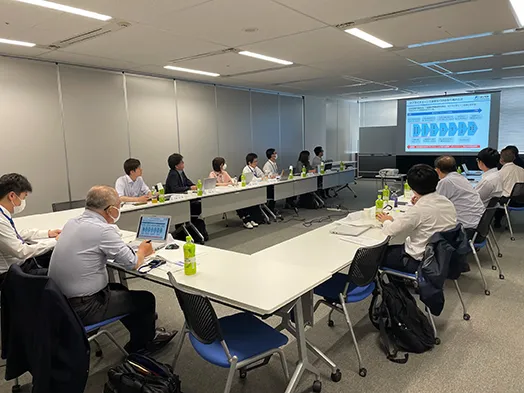
Every year, each factory and business site holds a "procurement policy explanation meeting" for local suppliers. In addition to sharing the CSR Procurement Guidelines, by communicating our key procurement measures as well as policies and initiatives regarding the environment, quality, compliance, and other areas, we enhance the effectiveness of sustainable procurement activities.
To promote Environmental Vision 2050, we launched joint decarbonization initiatives with suppliers.
In fiscal 2025, we held decarbonization management briefings, GHG reduction e-learning, and individual interviews tailored to supplier activity levels. In addition, to collect primary data for CFP (carbon footprint) calculation, we held CFP study sessions. Over 500 suppliers participated in the series of initiatives, deepening their understanding of our decarbonization policy and CFP calculation. Furthermore, through study sessions and interviews, we gained deep understanding of current issues and field realities at each company, providing a valuable opportunity for future activity support.
In fiscal 2026 as well, we plan study sessions on decarbonization and CFP calculation according to supplier needs. We will continue companion-style activity support for suppliers and promote decarbonization across the entire supply chain.
We promote communication and awareness activities with suppliers through the Declaration of Partnership Building.
In January 2026, accompanying the enforcement of the Act on Promotion of Subcontracting Small and Medium Enterprises (Amended Subcontracting Small and Medium Enterprises Promotion Act), we updated and registered our Declaration of Partnership Building.
Response to Conflict Minerals
Fuji Electric has a policy of not being complicit in acts that indirectly violate human rights through its supply chain. Fuji Electric and its affiliates promote prohibiting the use of minerals—tin, tantalum, tungsten, gold, cobalt, mica, and their derivatives—produced in conflict areas of the Democratic Republic of the Congo and surrounding countries that are involved in funding armed groups, human trafficking, forced labor, child labor, abuse, war crimes, and other human rights violations.
In addition, in February 2014, we joined JEITA's Responsible Minerals Trade Working Group as an official member, and will promote effective activities in collaboration with industry groups, including collecting the latest RMI information on conflict minerals. Note
-
*
-
RMI:Responsible Minerals Initiative
Rejecting Any and All Ties with Antisocial Forces
Fuji Electric continues to reject any and all ties with antisocial forces. In recent years, as funding activities of antisocial forces have become sophisticated, the Japanese government has also published guidelines to prevent damage. Fuji Electric and its affiliates have concluded memoranda of understanding concerning the rejection of antisocial forces with all new and continuing suppliers in Japan. In addition, when there are requests from suppliers such as concluding similar contracts, we respond in good faith.
Occupational Health and Safety in On-Site Construction Work
Fuji Electric outsources on-site construction work for power generation facilities and industrial equipment to specialized suppliers, and we undertake initiatives believing that occupational health and safety management in construction work is also an important responsibility of ours.
KYM (Kiken Yochi Meeting: Hazard Prediction Meeting) and TBM (Tool Box Meeting) to confirm safety matters for each construction work, tool inspections, and on-site safety patrols are conducted on a daily basis.
In addition, for large-scale construction, we organize health and safety councils with construction companies, and in addition to preparing materials regarding health and safety and issuing health and safety reports, we regularly conduct special education regarding work handling hazardous substances such as hydrogen sulfide.
In accordance with the revision of the Enforcement Regulations of the Construction Business Act in Japan, prime contractors are required to instruct subcontractors to enroll in social insurance, such as medical care and pensions, to promote public security for subcontractor workers.
Beginning with construction contracts dated November 1, 2012 onward, as a responsibility of a prime contractor, we confirm social insurance enrollment records of outsourced companies and compile a database. We then select and instruct outsourced companies based on this information.
