





Sustainability
Human Resource Development and Fair Evaluation

Basic Stance toward Human Resource Development
Fuji Electric views the development of employee skills as a top priority for management. In addition, having declared our promise to “Respect and value all people” in our Corporate Code of Conduct, we have announced our intent to reinforce human resource development programs to drive the growth of individual employees and to heighten the overall potential of teams. We are also proactive in providing education and training opportunities for employees to cultivate strong leadership and professionals with high expertise that lead to increased global competitiveness.
Education and Training Systems
As well as on-the-job training (ability development through work experience) in each workplace and specific education run by business divisions or sites, a wide array of education and training is provided through selective training targeting candidates for future management, cross-functional training across the company, and level-specific specialty training courses. We aim to achieve the growth of individuals, which is the source of our competitive strength, and to improve our comprehensive strength as an organization. In addition, age-specific career training provides self-analysis through workshops and visualization of career plans, as well as opportunities for interviews with career consultants, serving as an aid for employees' autonomous career development.
Our skill development system supports employee growth centered on level-specific, selective, and specialty training, global human resource development, and manufacturing education.
Level-Specific Training
In order to foster strong team building capabilities, level-specific training is provided at milestones such as promotion and appointment to help them improve their management skills, human skills, and logical thinking skills. A total of 1,566 individuals underwent such training in fiscal 2025.
Selective Training
We provide selective training to identify individuals with the potential to become division or business leaders at an early stage and to promote ongoing and companywide cultivation of candidates for future positions in senior management, incorporating external training that includes interaction with people from other companies. A total of 49 individuals underwent such training in fiscal 2025.
Specialty Training
The aim of specialty training is to enable employees to enhance their individual abilities and to learn specialized knowledge and skills. In particular, technology seminars are finely categorized and systematically structured by field and level. A total of 21,009 individuals underwent such training in fiscal 2025.
Manufacturing education
We focus on accumulating manufacturing technologies and expertise within the company, and on developing production engineers and technicians who can thrive at our domestic and international production sites.
In Japan, we provide a one-year specialized skills training program for new employees directly involved in manufacturing, as well as a three-month specialized technical training for newly appointed production engineers assigned to factory production technology departments. For mid-level technicians, we offer Manufacturing Mastery training to foster personnel with not only advanced technical skills but also excellent abilities in process improvement and rationalization. Additionally, each manufacturing site systematically plans education tailored to job categories, levels, and individual skill levels.
For overseas production engineers, we systematically provide technical education through core technology courses and practical on-site coaching.
Training on core technologies
Manufacturing technology and Management technique training for employees in production engineering and technical fields in Japan and overseas.
Manufacturing Digital Technology Training
Level-specific manufacturing digital talent development education aiming to realize digital twin factories from connected smart factories
-
Basic/Introductory Digital Technology Course (video learning)
-
Applied Digital Technology Course
-
Hands-on Digital Practice Training
-
Digital Technology Expert Training
Production Engineer Training by Level
Step-by-step training for production engineers to develop talent that can work globally, both domestically and overseas
Three-month intensive practical training for new university or technical college graduates in production engineering to rapidly develop production engineers with broad knowledge
Developing talent who can become workplace key players and lead others
Developing talent who can plan and propose the future of the workplace
Developing talents who can independently plan, propose, and implement new projects
2nd-Year Basic Technology Education
Basic technology education in manufacturing for all 2nd-year employees with university or technical college degrees.
◆ SCM/PLM Collaboration Courses
-
Product Planning Basics
-
Cost Management (Basic & Advanced)
-
Production Management Basics
-
Value Engineering (Basic & Advanced)
-
Industrial Engineering Basics
◆ Digital Application Course
-
DX (Digital Transformation) Basics
-
Product Value Basics
-
Smart Factory Basics
◆ FePS (Fuji Electric Production System) Basics
Supervisory Training
We conduct tier-specific training for supervisors at different levels (Manufacturing Supervisors, Work Leaders, and Work Team Leaders):
-
Manufacturing Supervisors: Focus on enhancing management skills for operations and personnel.
-
Work Leaders: As frontline supervisors, they develop leadership abilities that involve motivating and guiding teams both inside and outside the workplace.
-
Work Team Leaders: To improve on-site capabilities, they learn effective people management and work instruction techniques to strengthen operational leadership.
Manufacturing Mastery Training
Basic and applied education for mid-level work team leaders to acquire technical skills necessary for exceptional improvement and rationalization. Certified Manufacturing Masters receive incentives through bonuses to boost motivation and strengthen factory manufacturing capabilities.
New Employee Skills Training
-
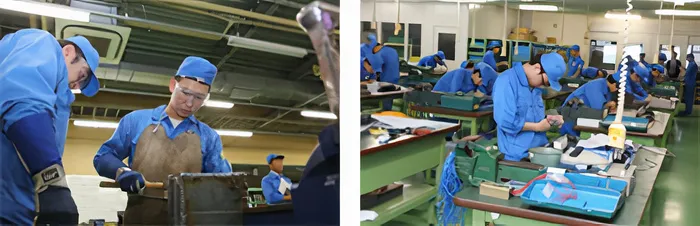
All new recruits with high school skills participate in a one-year, full-residency training program.
-
The goal is to establish a solid foundation for their technical careers and to develop personnel capable of immediate contribution by passing skills qualification exams.
Education and Training Aligned to the Promotion of Globalization
In order to provide maximum satisfaction to customers around the world, we believe it is important for employees hired in countries and regions outside Japan and employees in Japan to collaborate as one team across countries and regions to drive business forward, and we are working to cultivate globally competent employees who can undertake this.
Basic Policy for Cultivating Globally Competent Employees
We cultivate human resources who can create new value in teams with local employees in assigned countries through experiences of working and living abroad away from their home countries. Based on self-awareness and understanding of others, we value recognizing each individual's personality beyond differences in culture and customs by country or region, respecting and cooperating with each other.
We promote human resource exchange between Japan and overseas through the Global Specialist Program dispatching employees from Japan overseas, and the National Staff Program dispatching employees from overseas to Japan. In addition, through these programs, we promote the cultivation of future global human resources by acquiring job skills at assignment locations.
Furthermore, toward strengthening manufacturing capabilities at overseas production sites, we are working on planned cultivation of local production engineers. In addition, toward strengthening overseas sites, we identify key positions that significantly affect local management, and have commenced initiatives to select and nurture successor candidates.
Introduction of New Human Resources Development Programs
1.Cultivation of domestic employees—Global Specialist Program (about 5 employees dispatched per year)
To expand the pool of future global business leaders and accelerate global business growth, we conduct a program dispatching mid-level employees with a certain degree of domestic practical experience to overseas bases for approximately two years. A cumulative total of approximately 60 employees have been dispatched since the system was introduced in fiscal 2017.
2.Developing overseas recruits: National Specialist Program (about 20 employees accepted per year)
Toward cultivating human resources who can contribute to future overseas business expansion, we conduct an OJT training program accepting local overseas employees to Japan for approximately three months to one year. A cumulative total of approximately 160 employees have been accepted since the system was introduced in fiscal 2017.
3.Language skill improvement program—Fuji Global 1 (about 300 participants per year)
As business globalization progresses, strengthening language skills of employees dispatched overseas and key personnel serving as overseas contact points in Japan is extremely important. Implemented as a companywide integrated operation program since fiscal 2017, a cumulative total of 3,500 employees have taken the course. Providing opportunities to acquire globally applicable language skills to core human resources responsible for the future, we promote turning them into active global personnel.
Reskilling
To enable diverse human resources to achieve "autonomous and highly productive workstyles," we are engaged in human resource development such as reskilling according to business needs, upskilling toward productivity improvement, and support for autonomous career development.
In particular, as the world changes dramatically with the rapid spread of advanced DX technologies such as AI and IoT, we are actively working on developing digital human resources toward problem-solving using digital technology, creation of new value, and productivity improvement of internal operations. We conduct education toward improving DX literacy not only for engineers in charge of service development, but also for factory/production divisions and sales/service divisions close to customers. The cumulative number of participants in DX-related courses reached 39,026 over the five years from fiscal 2021 to fiscal 2025.
Training Hours and Training Expenses
(Hours)
A Fair Remuneration System
Fuji Electric has introduced a personnel remuneration system with a philosophy of "emphasis on performance and results" and "treatment according to the value of work."
In the remuneration system for management employees, we emphasize strengthening individual commitment toward achieving company performance goals, as well as developing human resources who will become future leaders, determining treatment annually based on goals, roles, and responsibility levels.
In the remuneration system for general employees, we previously adopted a job qualification system, but starting from fiscal 2026, we have made a fundamental revision to change to a remuneration system based on the size of roles similar to management employees. In various evaluation operations, supervisors and subordinates confirm expected roles, current fiscal year goals, processes, and results through interviews twice a year.
We make the philosophy of treatment consistent with Pay for Job and Pay for Performance, realizing fair treatment according to the current value of work.
