





Fuji Electric Review
Vol.71-No.4,2025
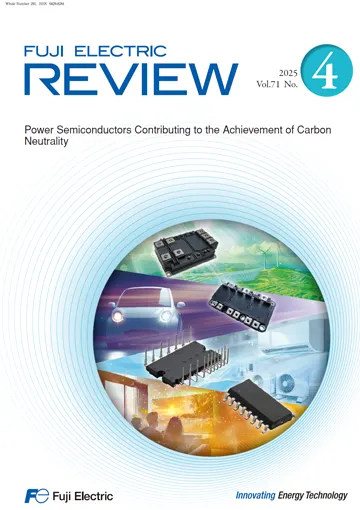
Power Semiconductors Contributing to the Achievement of Carbon Neutrality
Power Semiconductors Contributing to the Achievement of Carbon Neutrality
At present, expectations are rising for energy-saving technologies to achieve carbon neutrality worldwide, and Fuji Electric is contributing to this with power semiconductors, one of its core technologies. This special issue focuses on Fuji Electric’s innovative power semiconductor technologies, which are being used to reduce CO2 in electrified vehicles, increase the adoption of renewable energy, and develop industrial IPMs and power supply ICs that achieve energy savings and miniaturization of various devices.
It also explains in detail our latest developments, which include 3rd-generation trench gate SiC MOSFET devices and 8th-generation IGBT devices, both of which will help form the foundation of future power semiconductor technologies.
IWAMURO, Noriyuki
ONISHI, Yasuhiko; MIYASAKA, Tadashi; IKAWA, Osamu
Fuji Electric is playing an important role in power semiconductors, one of its core technologies, amid growing expectations for energy-saving technologies worldwide to achieve carbon neutrality. Its semiconductor business is expanding over the medium to long term by contributing to the reduction of CO2 emissions through electrification of automobiles and miniaturization and energy saving of power electronics equipment. In particular, we are strengthening the development of power semiconductor modules for electrified vehicles and renewable energy, whose demand continues to grow, and promoting the development of next-generation devices for applicable Si-IGBTs and SiC-MOSFETs. We are also developing intelligent power modules (IPMs), which contribute to energy saving of home appliances such as air conditioners, and power supply control ICs, which contribute to efficiency improvement in switching power supplies.
SATO, Yushi; IMAI, Eiji; YAMADA, Takafumi
In pursuit of carbon neutrality, Fuji Electric has developed the industry’s smallest power modules designed for light and compact vehicles with a motor output of 50 to 100kW. By combining direct liquid-cooling structures, which cool the Cu baseplate using a water jacket, with a lead-frame-wired internal circuit, these power modules have been downsized and made low-profile. In addition, for the package structure in which the circuit board is encapsulated with gel, the lead-frame geometry was optimized and a high-strength solder was employed at the joints. As a result, the ΔTvj power cycle reliability has been improved without introducing additional process steps, thereby ensuring the high reliability required for automotive applications.
SHIBASAKI, Yuta; TANAKA, Masanori; OGUCHI, Takuya
As home appliances become more energy efficient, intelligent power modules (IPMs) with a built-in three-phase inverter bridge circuit, control circuit, and protection circuit are becoming more widespread. In response to the demand for smaller and more efficient inverters, Fuji Electric has recently developed the “P641 Series” of 3rd-generation, small IPMs featuring reduced size and lower loss. By applying an improved 7th-generation RC-IGBT, high-heat- dissipation resin insulation sheet, and lead frame structure, this series has 44% smaller installation area and 5% smaller startup losses than the “P633C Series.” Furthermore, we have added, for the first time in this package size, a 40-A rated product that meets the increased capacity requirements of large home appliances such as air conditioners.
YAGUCHI, Yukihiro; YABUZAKI, Jun; KAMAKURA, Ryoma
In recent years, switching power supplies equipped with power factor correction (PFC) circuits, which reduce harmonic currents to improve power factor, have been increasingly adopted to improve the efficiency of electronic equipment. Fuji Electric has recently developed the “FA1C20N” critical mode interleaved PFC control IC for controlling PFC circuits used in switching power supplies with relatively high load power ratings of 200W or more. Using our proprietary control technology prevents audible noise generation during operation mode switching aimed at improving efficiency, enhances load-following performance, and suppresses harmonic current generation to ensure compliance with the Class C requirements of the International Standard IEC 61000-3-2. Furthermore, providing a current detection resistor for each switching element achieves high-precision overcurrent protection.
TOYODA, Yoshiaki; HAYASHI, Shingo; ICHIKAWA, Yoshihito
Fuji Electric has developed a 3rd-generation SiC trench MOSFET chip to meet the demand for higher efficiency and smaller size for power devices used in electric vehicles and solar and wind power generation systems, which are increasingly being adopted toward a decarbonized society. By simplifying and miniaturizing the chip structure, this chip has 23% smaller specific on-resistance than the 2nd-generation one. In addition, we have suppressed both time-dependent shift in gate threshold voltage associated with continuous gate-voltage application and increases in on-state resistance due to body-diode conduction, thereby ensuring high reliability.
IKURA, Yoshihiro; NAITO, Tatsuya; KISHI, Tomoya
Amid the shift toward renewable energy and the electrification of mobility, there is an increasing demand for enhanced performance in IGBT modules for power conversion equipment. To address this demand, Fuji Electric has developed 8th-generation IGBT and FWD chips that exhibit lower losses while preserving the robustness of the preceding generation. When integrated into IGBT modules and tested under operating conditions representative of power-conditioning systems (PCSs) for renewable-energy applications, these chips achieve a 10% reduction in losses compared with 7th-generation chips. Such loss reduction contributes to further improvements in efficiency, miniaturization, and reliability of power conversion equipment.
HIROSE, Takayuki; OHUCHI, Yuki; SAEKI, Hidenori
To accelerate the development of semiconductor devices, Fuji Electric is promoting the use of molecular-level calculations that enable manufacturing processes and conditions to be evaluated without the need for device prototyping or analysis. Taking a SiC-MOSFET as an example, in order to improve electron mobility for reduced loss, we investigated processing conditions that enable the introduction of nitrogen atoms to improve electron mobility at the interface between the gate oxide film and SiC, while reducing C = C bonds that degrade electron mobility. Applying molecular dynamics calculations elucidated a reaction mechanism that had not been identified through conventional prototyping and analysis. As a result, we estimated the processing conditions to form an optimal interface structure within a short period of time using simulation, without prototyping.
[Regular Paper]
FUJIHIRA, Tatsuhiko
Previously, optimum designs for Si (silicon) unipolar devices had only been established for the non-punch-through (NPT) type, but Fuji Electric has recently elucidated optimum designs for punch-through (PT) type devices, which are used in most products. We proposed new optimum design guidelines for PT-type Si devices and elucidated that the optimum width of the drift region of PT-type Si unipolar devices is nine-eighth the value previously regarded as optimum at the same doping density. According to these guidelines, the ideal specific on-resistance (Si limit) for the PT type is approximately 12% lower than the one previously reported for the NPT type, indicating the potential to create devices with lower losses.
