

Share





 Products & Solutions Top
Drives & Controls
UPS & Industrial Power Supply
Sensors & Measurements
Energy Management
Monitoring & Control System
Distributions & Controls
Transmission & Distribution
Transit System
Semiconductors
Energy
Food and Beverage Distribution
Service & Equipment Upgrades
Solutions
Ensuring Product Security
Products & Solutions Top
Drives & Controls
UPS & Industrial Power Supply
Sensors & Measurements
Energy Management
Monitoring & Control System
Distributions & Controls
Transmission & Distribution
Transit System
Semiconductors
Energy
Food and Beverage Distribution
Service & Equipment Upgrades
Solutions
Ensuring Product Security
Share

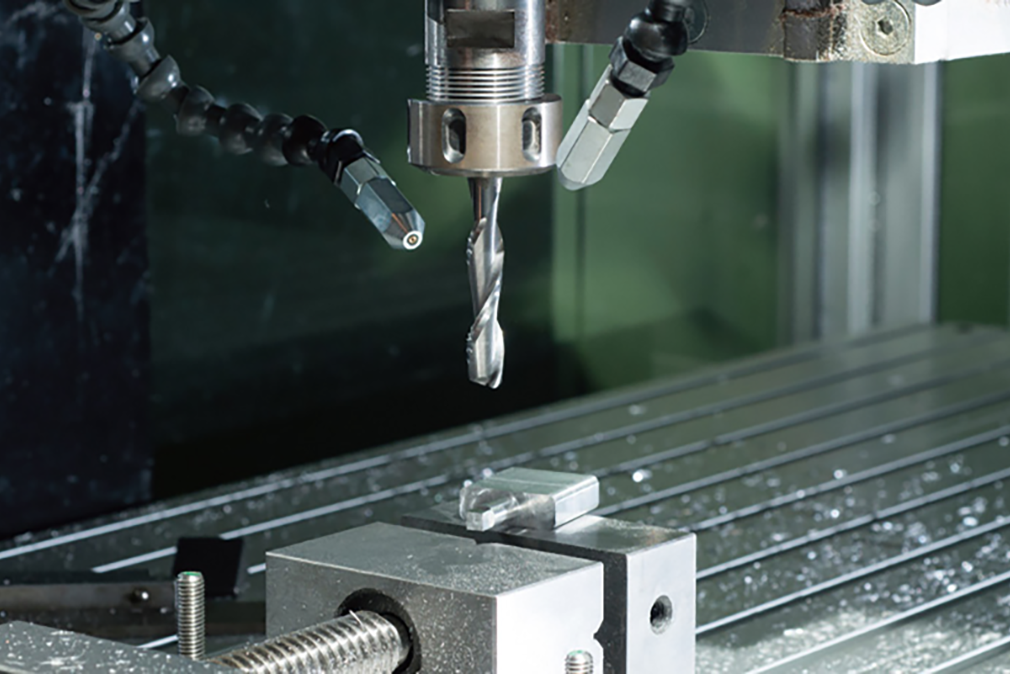
In "machining lines", where machine tools are used to process metal materials into desired shapes, NC machine tools, which allow for uniform machining through numerical control (NC), are widely used. Among them, machining centers equipped with an Automatic Tool Changer (ATC) function can perform complex machining continuously without the need for operators to change tools. However, in a machining line with such advanced automation, there is a possibility of overlooking sudden tool breakage. Since continuing machining with a broken tool can cause various problems, it is necessary to have a system that can reliably detect tool breakage. This article introduces methods for detecting tool breakage, focusing mainly on cutting tools (blades), and includes samples of actual efforts.
Tool breakage refers to a phenomenon where a cutting tool literally breaks during machining. When a tool breaks, since it becomes impossible to properly machine subsequent workpieces afterwards, the broken tool needs to be replaced.
The direct cause of tool breakage is that a load exceeding the allowable limit is applied to the tool during processing, but there are various possible causes of excessive load, such as the following examples:
Tools (blade shape, number of blades, material, wear condition, mounting defects, etc.)
Machine tools (feed rate, rotation frequency, cutting depth, individual differences, etc.)
Workpieces (processing status of previous process, material, etc.)
Chips (poor discharge, etc.)
Cutting oil (hydraulic pressure, liquid temperature, type, etc.)
Ambient environment (temperature, vibration, etc.)
In fact, tool breakage may occur due to a combination of several conditions listed above. Therefore, it is necessary to take appropriate measures after analyzing and identifying the true causes of breakage based on the situation at each production site.

There may be various causes of tool breakage, but when tool breakage actually occurs, what kind of problems does it actually cause on the production floor?
The first is the occurrence of defective losses. In particular, in unmanned continuous automated processing lines, if processing continues without noticing a tool breakage, defective products that do not meet the machining quality may be produced. Until the processing defect is noticed and the equipment is stopped, all the costs and time spent on processing the defective products are wasted, resulting in significant defective losses.
The second is an increase in man-hours for quality checking. If it is not possible to clearly identify the exact time when the tool breakage occurred, there may be a case where it is necessary to inspect all suspect workpieces machined during a certain period of time to check for any machining defects. Not only does this create extra work for the personnel in the quality control department, but also the operating rate will drop even further if the production has to be temporarily halted until the quality check is completed.
As mentioned above, quick and reliable detection of tool breakage is an important effort to minimize production losses in machining line. Then, what methods are available for actually detecting tool breakage? Following there will be introduced three typical detection methods.
The first method involves directly contacting a sensor with the tool to check if the tool is broken or not. Specifically, after processing is completed, a sensor that brings a needle into contact with the tool is installed inside the processing machine to confirm that the tool is not broken.
An advantage of contact-type sensors is that they are less affected by external disturbances such as coolant or oil mist, resulting in fewer false detections. However, there is also a disadvantage that the cycle time becomes longer by the amount of time needed for the needle to make contact (approximately 1 to 2 seconds). In addition, it is also difficult to detect breakage or small chips in the tool which have occurred below the point where the needle makes contact.
The second method involves using non-contact sensors, such as laser sensors, to check if the tool is broken or not. Its concept is the same as that of a contact sensor in that the condition of the tool is directly checked, but it uses a non-contact method such as laser irradiation.
One of the advantages of non-contact sensors is that they can determine whether a tool is broken or not faster than contact-type sensors. A disadvantage is that if the laser irradiation area becomes contaminated with coolant or oil mist inside the processing machine, there is a higher risk of false detection.
The third method is to indirectly detect tool breakage by capturing the changes before and after a tool breakage as data. Vibration sensors, current sensors, power sensors, etc. are used as the sensors to collect data.
An advantage of adopting this method is that the length of the cycle time is not affected since tool breakage can be detected during machining (in real time). In addition, by monitoring changes in data trends, it may be possible to detect early signs of tool abnormalities before tool breakage occurs. However, it requires more specialized knowledge than other methods since it is necessary to set evaluation criteria for each tool and processing condition.
Fuji Electric has introduced the tool diagnostic system "OnePackEdge MARSYS" to a number of machining lines as a product that can be used to detect tool breakage. This product is a system that easily "visualizes" the machining condition and "diagnoses" the tool condition by measuring the load power of the spindle motor of a cutting machine in real time using a dedicated power sensor. It is possible to perform more accurate diagnostics and detection according to the processing conditions since the dedicated analysis support software "ProHealth" can be used to set the thresholds for each tool or workflow.
Immediate detection of tool breakage has been enabled in the production sites of customers who have implemented this product, which has led to benefits such as preventing large amounts of defective processing losses and the flow of defective products to the next process. In addition, a significant improvement in productivity has been achieved owing to the shorter machining cycle since the time previously needed to diagnose tool breakage after machining has no longer been required.
So far, we have discussed the types of problems caused by tool breakage and the detection methods used to prevent them. How did you find it? I believe you now understand the importance of having a system to reliably detect tool breakage in the machining line.
Fuji Electric offers the tool diagnostic system "OnePackEdge MARSYS" that has long contributed to the detection of tool breakage at customer production sites for many years. If you are interested in this product, please feel free to contact Fuji Electric using the link below.
What Is The Life of a Tool? Explains The Types of Damage and The Methods of Life Management
March 12,2026

What Is A Smart Factory?
March 4,2026
Factory automation offers companies a great opportunity for profit.
January 20,2021