

Share





 Products & Solutions Top
Drives & Controls
UPS & Industrial Power Supply
Sensors & Measurements
Energy Management
Monitoring & Control System
Distributions & Controls
Transmission & Distribution
Transit System
Semiconductors
Energy
Food and Beverage Distribution
Service & Equipment Upgrades
Solutions
Ensuring Product Security
Products & Solutions Top
Drives & Controls
UPS & Industrial Power Supply
Sensors & Measurements
Energy Management
Monitoring & Control System
Distributions & Controls
Transmission & Distribution
Transit System
Semiconductors
Energy
Food and Beverage Distribution
Service & Equipment Upgrades
Solutions
Ensuring Product Security
Share

Various tools, such as drills for cutting and grinding wheels for polishing, are used in a "machining line" where machine-tools are used to process metal materials into the desired shape, depending on the processing conditions, such as the type of processing, the material of the workpiece, and the required processing accuracy. Continuing to use a tool excessively worn out even though it has reached the end of its life can deteriorate the machining quality of workpieces, so it is necessary to replace it at an appropriate interval. However, on the other hand, frequent replacement can create unnecessary costs, which is also a problem. Therefore, optimal management of tool life is an important effort in a machining line. This article primarily focuses on cutting tools (cutting edges) and provides the information useful for properly managing the life of such tools.
In order to properly manage the life of a tool, while it is necessary for the production site to determine when a tool's life has come to an end, at what point is it generally considered to be the end of the tool's life?
In the "Tool life" entry in the Mechanical Engineering Dictionary published by the Japan Society of Mechanical Engineers, it is defined as "the net cutting time until a cutting tool is damaged or worn to the point it becomes no longer suitable for use, usually expressed in minutes. At the production site, the criteria for judging the tool life in the production settings include changes in product dimensional accuracy, finished surface roughness, or changes in chip shape, while in the laboratory settings, it is considered to be the point at which the wear width of the flank face or the wear depth on the cutting face reaches a certain value." In other words, it is possible to say that the "tool life" in the production field is defined as the point at which the tool can no longer perform machining that meets the standards for machining the accuracy and surface roughness required for product quality.
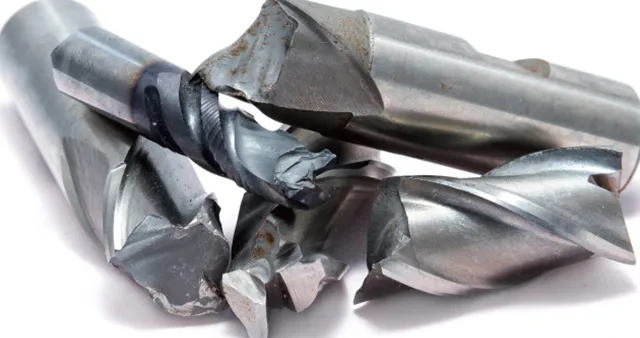
Since machine-tools cut workpieces by applying a large force through the cutting tools, the tools are always placed in harsh environments. Therefore, while tool deterioration is inevitable, what types of damage can they sustain?
Damage that occurs suddenly, regardless of the period in which the tool has been used, is called brittle damage. The terminology varies depending on the state of damage: small chips on the cutting edge are generally called chipping, larger chips are referred to as fracture, and damage affecting the cutting edge or the entire tool is called breakage. In addition, there are also other damage forms such as peeling and cracking.
Other than brittle damage, progressive damage that occurs mainly in proportion to the period of tool use is called wear. This is not sudden damage, but rather damage that gradually progresses each time the tool is used. Among wear types, it can be divided into "mechanical wear proportional to the cutting distance" and "thermal wear greatly affected by the cutting temperature."
If the tool is damaged, it will no longer be possible to perform processing that meets the product quality standards. Such a tool has reached the end of its lifespan and needs to be replaced as needed, but how should the timing of its replacement be managed?
A simple method is to replace the tool after confirming the occurrence of defective processing. In the general classification of equipment maintenance methods, this is the type called corrective maintenance.
An advantage is that it is easy to determine the tool life. A disadvantage is that when using sampling inspection rather than total inspection, there is a possibility that many processing defects have already been overlooked by the time a processing defect is discovered. In such a case, the damage would also spread to the next process.
There is also a method to replace the tool based on its usage time or number of uses. The end of the tool life is defined as the time when the tool can be replaced with some margin before it is damaged, thereby preventing an occurrence of defective processing. In the general classification of equipment maintenance methods, this is called preventive maintenance.
While the advantages are that setting the replacement period is relatively easy and there is a high possibility of preventing machining defects, the disadvantages are that there is a possibility that a tool that is still usable may be judged to have reached the end of its life and replaced, and that machining defects caused by sudden tool damage cannot be prevented.
In recent years, there are also methods for managing tool life by attaching various sensors to measure data during machining and quantitatively monitoring the wear condition of tools. In the general classification of equipment maintenance methods, this is the method called predictive maintenance.
An advantage is that by replacing each tool at the appropriate time according to its condition, it is possible to prevent machining defects while minimizing tool replacement costs. The disadvantages are that it includes the effort and cost required to monitor the condition of the tools, and it is relatively difficult to set replacement criteria.
Then, what methods are there to extend the tool life while preventing negative impacts on the product quality?
As mentioned above, the tool life due to wear is generally determined in proportion to the length of time the tool has been used. However, since the actual life can vary depending on the processing and environmental conditions at the time, the replacement period inevitably has to be set with some margin with respect to the actual life, if the standard usage time is used as the replacement criterion. Therefore, in order to use tools for as long as possible, it is recommended to replace them based on the condition standards (predictive maintenance) according to the actual deterioration of the tools.
Fuji Electric offers the tool diagnostic system "OnePackEdge MARSYS" in its lineup as a product that can be used to manage tool life. This product is a system that easily "visualizes" the machining condition and "diagnoses" the tool condition by measuring the load power of the spindle motor of a cutting machine in real time using a dedicated power sensor. It is possible to perform more accurate diagnostics according to the processing conditions since the dedicated analysis support software "ProHealth" can be used to set the thresholds for each tool or workflow. It is possible to create a guideline to use tools up to their maximum life by using "OnePackEdge MARSYS" to accumulate measurement waveforms for each tool during every machining cycle. This enables to shift from tool replacement based on the usage time, to tool replacement based on the deterioration state of each tool.
What Is The Method to Detect Tool Breakage?
March 12,2026

What Is A Smart Factory?
March 4,2026
Factory automation offers companies a great opportunity for profit.
January 20,2021