


Share





 Products & Solutions Top
Drives & Controls
UPS & Industrial Power Supply
Sensors & Measurements
Energy Management
Monitoring & Control System
Distributions & Controls
Transmission & Distribution
Transit System
Semiconductors
Energy
Food and Beverage Distribution
Service & Equipment Upgrades
Solutions
Ensuring Product Security
Products & Solutions Top
Drives & Controls
UPS & Industrial Power Supply
Sensors & Measurements
Energy Management
Monitoring & Control System
Distributions & Controls
Transmission & Distribution
Transit System
Semiconductors
Energy
Food and Beverage Distribution
Service & Equipment Upgrades
Solutions
Ensuring Product Security
Share
Achieving Remarkable Energy Savings for Liquid-Cooled Data Centers The first in the world! Launching an Ejector Cooling Unit
 (206KB)
May 27,2026
Fuji Electric Co., Ltd.
Fuji Electric Co., Ltd. is pleased to announce that it has developed the world’s first ejector cooling unit capable of reducing power consumption for cooling servers in data centers by up to 85%, and that it will be available for sale in June 2026.
1. Background
As generative AI spreads, data center power consumption is increasing rapidly. Reducing the amount of power used for server cooling, which accounts for 30 to 40% of data center power consumption, is a key issue for data center operators as they expand their capacity.
Conventionally, servers were generally cooled with air-cooling systems that use air conditioners, but as heat generation has increased due to higher server performance, the mainstream method is shifting toward water-cooling systems, which cool servers by circulating cold water. Data Centers mainly use chillers (refrigerators) to generate this cold water, but now Fuji Electric has developed a revolutionary new cooling unit: the ejector cooling unit. Replacing chillers with FE’s ejector cooling unit can reduce server cooling power consumption by up to 85% (when used over a three-month summer period), helping data center operators to address their power challenges.
The company is also currently developing a container system that will reduce installation time and construction costs by connecting multiple ejector cooling units and storing them in a container together with ancillary equipment.
2. About Ejector Cooling Units
Liquids and gases tend to heat up when compressed and cool down when expanded. Chillers and ejector cooling units use this principle to produce cold air.
Chillers use a compressor to compress refrigerant, and this consumes a large amount of electricity. The ejector cooling unit, in contrast, does not use a compressor; instead, it recycles waste heat from servers as energy and uses FE’s proprietary fluid compressor (ejector) to compress and circulate refrigerant gas.
This waste heat is transferred to the ejector cooling unit via the coolant distribution unit (Figure 1).
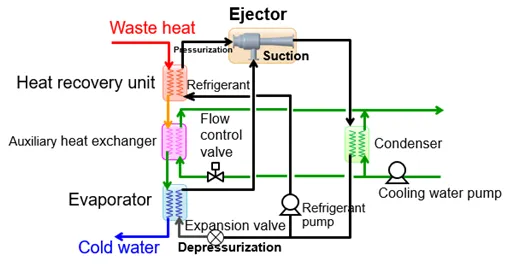
The ejector cooling unit is composed of an ejector, a heat recovery unit to recover waste heat from the servers, and an evaporator to extract cold air from the refrigerant (Figure 2). Since the refrigerant pressure increases as the temperature is raised, the heat recovered from the servers is used to raise the pressure of the refrigerant, while the low-pressure, low-temperature refrigerant is pulled up and extruded after cold water is produced by the ejector. Then, the expansion valve expands (depressurizes) it all at once to lower the temperature, and cold water is generated by the evaporator.
The ejector consists of a supersonic nozzle and a pressurization diffuser. The supersonic nozzle has a narrow tip that increases the flow rate of the refrigerant above the speed of sound. The fluid pressure increases as the speed slows down. The pressurization diffuser is designed to expand in a smooth curve (arc shape) in the direction of the outlet, making it possible to decelerate and compress supersonic refrigerant without energy loss and compress it efficiently.
3. Standard Specifications
4. Launch Date
Late June 2026
5. Inquiries
Thermal Solution Technology Department, Automation Systems Division, Industry Business Group, Fuji Electric Co., Ltd.
Email: heat-pump@fujielectric.com
Figure 1: Overall configuration
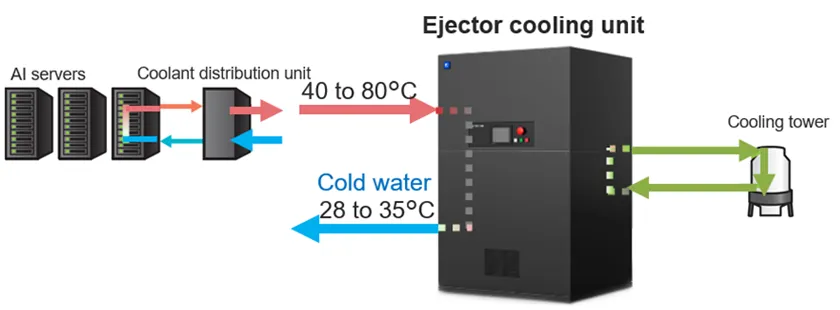
Figure 2: Ejector cooling unit configuration
*The information conveyed in this release is accurate as of the date of this announcement and is subject to change without prior notice.
