Fuji Electric’s corporate governance framework consists of the Board of Directors, which performs the functions of management supervision and making important decisions, and Audit & Supervisory Board Members and the Audit & Supervisory Board, which perform the function of management audits, ensuring that the framework guarantees objectivity and neutrality.
The Company actively appoints Outside Directors and Audit & Supervisory Board Members that satisfy the requirements for independence, endeavors to strengthen management supervisory and auditing functions, and has established the Nomination and Remuneration Committee comprising a majority of Outside Directors as an advisory body to the Board of Directors, and the majority of its members and its chairman are Outside Directors.
In addition, in order to clarify the roles of management and execution, we have introduced an executive officer system to clarify the responsibilities for each business. In order to continue strengthening our operating platform as a company with sustainable growth, in fiscal 2022 we appointed a Chairman of the Board and CEO and President and COO. We are endeavoring to build an effective corporate governance framework by establishing the Executive Committee, which discusses and reports on important matters related to management as an advisory body to the Chairman of the Board and CEO and President and COO, as well as other committees tasked with planning and promoting key business strategy issues and key external issues, such as legal compliance.
Major Regulations and Committees Comprising Internal Control Systems
ปรัชญาองค์กร
จรรยาบรรณธุรกิจของบริษัท Fuji Electric
Fuji Electric Job Authority Rules
Fuji Electric Compliance Promotion Committee
Fuji Electric Compliance Regulations
โปรแกรมการปฏิบัติตามข้อกำหนดของฟูจิ อิเล็คทริค
Business Ethics Whistle-Blowing Systems
Fuji Electric Risk Management Rules
Fuji Electric Rules for Prevention of Insider Trading
Fuji Electric Group Contingency Plan for Emergency Situations
Auditor Liaison Committee etc.
* Committees
[Key issues for Fuji Electric from
a sustainability perspective]
คณะกรรมการด้านความยั่งยืน
[Legal compliance and other key
external issues]
Fuji Electric Compliance Promotion Committee
คณะกรรมการส่งเสริมสุขภาพและความปลอดภัย
[Key business strategy issues]
คณะกรรมการพัฒนาทักษะ
คณะกรรมการเทคโนโลยีการผลิต
คณะกรรมการพัฒนาเทคโนโลยี
การกำหนดมาตรฐานสากล คณะกรรมการ
Outside Directors Ratio
Outside Directors 4 people / All Directors 10 people
40.0%
Outside Directors and Audit & Supervisory Board Members Ratio
Outside Directors and Audit & Supervisory Board Members 7 people / All Directors and Audit & Supervisory Board Members 15 people
46.7%
Female Directors Ratio
Female Director 1 person / All Directors 10 people
10.0%
Female Directors and Audit & Supervisory Board Members Ratio
Female Directors and Audit & Supervisory Board Members 2 people / All Directors and Audit & Supervisory Board Members 15 people
13.3%
Nomination and Remuneration Committee Outside Directors and Audit & Supervisory Board Members (Outside Directors) Ratio
Outside Directors and Audit & Supervisory Board Members 4 people / All Committee Members 6 people
66.7%
หน่วยงานกำกับดูแลและตรวจสอบบัญชี
คณะกรรมการบริหาร
คณะกรรมการสรรหาและพิจารณาค่าตอบแทน
คณะกรรมการตรวจสอบและกำกับดูแล
Role
Management supervision and decision-making
Advisory body to the Board of Directors
Management audits
Chairman /
Committee Chairman
Chairman of the Board and CEO
Michihiro Kitazawa
Outside Director
Toshihito Tamba
Standing Audit & Supervisory Board Member
Junichi Matsumoto
Main Topics of Discussion, Review, and Deliberation
■ Management strategy, sustainability, and governance (management plans and business strategies, SDG issues, statuses of compliance and risk management initiatives, etc.)
■ Financial results and financial affairs (monthly, quarterly, and annual results and forecasts; risks of loss; content of external disclosures, etc.)
■ Dividends from surplus (dividend policy, dividend payout ratio policy, policy on explanations to stakeholders, etc.)
■ Cross-shareholdings (policy on holding and selling, rationale for holding, etc.)
■ Organizational changes and personnel reassignments (purpose and details, division of executive roles, skill matrix, etc.)
■ Advisory matters
นโยบายเกี่ยวกับองค์ประกอบของคณะกรรมการบริษัท
Policy and criteria for the appointment or dismissal of Directors, the President and Chairman of the Board of Directors, and Audit & Supervisory Board Members
Appointment and dismissal of Directors, the President and Chairman of the Board of Directors, and Audit & Supervisory Board Members
Matters related to the formulation and implementation of a succession plan for the President and Chairman of the Board of Directors
Policies and criteria for the remuneration of Directors and Audit & Supervisory Board Members
■ In fiscal 2025, the following matters were deliberated on and reported to the Board of Directors:
Officer remuneration
Performance-related share-based remuneration plan
Officer personnel matters
Annual activity plan for the Nomination and Remuneration Committee, etc.
■ Offering of opinions at meetings of the Board of Directors, Executive Committee, Fuji Electric Compliance Promotion Committee, and other important committees
■ Review of important approval documents, etc.
■ Meetings with the President and COO
■ Receipt of explanations on the status of operational execution from Directors, internal auditing divisions, etc.
■ Investigation of the statuses of operations and assets, etc. of the Company and its affiliate companies
■ Review of the audit methods and results of the Accounting Auditors
Number of meetings per year
13
4
9
หน่วยงานที่ดำเนินธุรกิจ
คณะกรรมการบริหาร
คณะกรรมการด้านความยั่งยืน
Fuji Electric Compliance Promotion Committee
คณะกรรมการส่งเสริมสุขภาพและความปลอดภัย
Role
Advisory body to the Chairman of the Board and CEO and the President and COO, deliberation and reporting on important matters concerning management
Deliberation on issues related to the promotion of sustainability, evaluation of measures
Ensuring thorough compliance with laws, regulations and social norms applicable to Fuji Electric
Drafting and deliberation of Fuji Electric's health and safety policy, and promotion of safety management
Key Members
Chairman of the Board and CEO, President and COO, Executive Officers, Standing Audit & Supervisory Board Members
Corporate General Manager, Corporate Management Planning Headquarters; General Manager, Human Resources and General Affairs Office; Corporate General Manager, Production & Procurement Group; Corporate General Manager, Power Electronics Sales Group; Corporate General Managers of Business Groups; Corporate General Manager, Corporate R&D Headquarters
President and COO; Corporate General Manager, Corporate Management Planning Headquarters; General Manager, Human Resources and General Affairs Office; Corporate General Manager, Power Electronics Sales Group; Corporate General Managers of Business Groups; Corporate General Manager, Production & Procurement Group; Corporate General Manager, Corporate R&D Headquarters; Standing Audit & Supervisory Board Members; attorneys
General Manager, Human Resources and General Affairs Office; General Managers of major production and sales bases in Japan
Number of meetings per year
24 (twice a month)
2
2
1
คณะกรรมการพัฒนาทักษะ
คณะกรรมการเทคโนโลยีการผลิต
คณะกรรมการพัฒนาเทคโนโลยี
การกำหนดมาตรฐานสากล คณะกรรมการ
Role
Promoting cross-functional skills development for Fuji Electric as a whole
Deciding on and ensuring thorough communication of policies for improving Fuji Electric's production technology capabilities
Promoting taking on the challenge of new technologies and their commercialization, and the development of products that match market trends, leading company-wide research by formulating policies and selecting themes
Deciding on and promoting policies for advancing international standardization
Key Members
General Manager, Human Resources and General Affairs Office; Corporate General Manager, Power Electronics Sales Group; Corporate General Managers of Business Groups; Corporate General Manager, Production & Procurement Group; Corporate General Manager, Corporate R&D Headquarters
Corporate General Manager, Production & Procurement Group; Corporate General Managers of Business Groups; Corporate General Manager, Corporate R&D Headquarters
Corporate General Manager, Corporate R&D Headquarters; Corporate General Manager, Corporate Management Planning Headquarters; Corporate General Manager, Power Electronics Sales Group; Corporate General Managers of Business Groups; Corporate General Manager, Production & Procurement Group
Corporate General Managers of Business Groups; Corporate General Manager, Corporate R&D Headquarters; Corporate General Manager, Power Electronics Sales Group; Corporate General Manager, Production & Procurement Group
Representative Director
Chairman of the Board and CEO
(Chief Executive Officer)
Nomination and Remuneration Committee Member
●
●
●
●
●
●
●
ชิโระ คอนโดะ
Representative Director
President and COO
(Chief Operating Officer)
President Executive Officer
Nomination and Remuneration Committee Member
●
●
●
●
●
●
●
โทชิฮิโตะ ทัมบะ
ผู้อำนวยการภายนอก
Nomination and Remuneration Committee Chairman
●
●
●
●
ยูคาริ โทมินากะ
ผู้อำนวยการภายนอก
Nomination and Remuneration Committee Member
Outside Director, MORINAGA MILK INDUSTRY CO., LTD.
●
●
●
ยูกิฮิโระ ทาชิฟูจิ
ผู้อำนวยการภายนอก
Nomination and Remuneration Committee Member
Outside Director, artience Co., Ltd.
●
●
●
●
●
โทโมนาริ ยาชิโระ
ผู้อำนวยการภายนอก
Nomination and Remuneration Committee Member
President, Tokyo City University
●
●
●
โทรุ โฮเซ็น
Director
Senior Managing Executive Officer
Corporate General Manager, Semiconductors Business Group
●
●
●
ฮิโรชิ เท็ตสึทานิ
Director
Managing Executive Officer
Corporate General Manager, Industry Business Group
●
●
●
มาซาชิ คาวาโนะ
Director
Senior Managing Executive Officer
Corporate General Manager, Energy Business Group
●
●
●
โยชิทาดะ มิโยชิ
Director
Senior Managing Executive Officer
Corporate General Manager, Corporate Management Planning Headquarters
General Manager, Export Administration Office
In charge of compliance management
[Board of Directors] Attendance 13/13
Mr. Tamba offered opinions as necessary on all areas of Fuji Electric's management, including on the following matters based on his professional standpoint and considerable insight as an experienced manager at listed companies.
• Formulation of a business plan taking into account changes in the market environment
• Appropriate ways to carry out IR activities
[Nomination and Remuneration Committee] Attendance: 4/4
As the committee chairman, Mr. Tamba led the supervisory function in appointment of candidates for Directors and Audit & Supervisory Board Members of the Company and the process of determining remunerations for Directors and Audit & Supervisory Board Members from an objective and neutral standpoint.
ยูคาริ โทมินากะ
[Board of Directors] Attendance 13/13
Ms. Tominaga offered opinions as necessary on all areas of Fuji Electric's management, including on the following matters, based on her abundant experience and considerable insight pertaining to corporate management.
• How to promote the active participation of diverse human resources
• How to approach IT investment initiatives
[Nomination and Remuneration Committee] Attendance: 4/4
Ms. Tominaga carried out the supervisory function in appointment of candidates for Directors and Audit & Supervisory Board Members and the process of determining remunerations for Directors and Audit & Supervisory Board Members from an objective and neutral standpoint.
ยูกิฮิโระ ทาชิฟูจิ
[Board of Directors] Attendance: 13/13
Mr. Tachifuji offered opinions as necessary on all areas of Fuji Electric's management, including on the following matters, based on his professional standpoint and considerable insight as an experienced manager at listed companies.
• Inventory optimization initiatives
• Enhancement of risk management in plant projects
[Nomination and Remuneration Committee] Attendance: 4/4
Mr. Tachifuji carried out the supervisory function in appointment of candidates for Directors and Audit & Supervisory Board Members and the process of determining remunerations for Directors and Audit & Supervisory Board Members from an objective and neutral standpoint.
โทโมนาริ ยาชิโระ
[Board of Directors] Attendance 13/13
Mr. Yashiro offered opinions on the following matters and other general management matters of Fuji Electric based on his expertise in and high-level insight into sustainable construction and innovation management.
• Initiatives to achieve a decarbonized society
• Enhancement of risk management in plant projects
[Nomination and Remuneration Committee] Attendance: 4/4
Mr. Yashiro carried out the supervisory function in appointment of candidates for Directors and Audit & Supervisory Board Members and the process of determining remunerations for Directors and Audit & Supervisory Board Members from an objective and neutral standpoint.
คณะกรรมการตรวจสอบและกำกับดูแลภายนอก
คณะกรรมการตรวจสอบและกำกับดูแลภายนอก
ชื่อ
กิจกรรมหลัก
ฮิโรฮิโกะ ทาคาโอกะ
[Board of Directors] Attendance: 13/13
Mr. Takaoka confirmed and offered opinions as necessary concerning agenda items and the status of Fuji Electric's business activities based on his extensive experience and considerable insight as an experienced Full-time Audit & Supervisory Board Member and any other type of executive of listed companies.
[Audit & Supervisory Board] Attendance: 9/9
Mr. Takaoka confirmed and offered opinions on the legal compliance of the overall business activities of Fuji Electric.
ยูโกะ คัตสึตะ
[Board of Directors] Attendance: 13/13
Ms. Katsuta confirmed and offered opinions as necessary concerning agenda items and the status of Fuji Electric's business activities based on her expert knowledge as an attorney.
[Audit & Supervisory Board] Attendance: 9/9
Ms. Katsuta confirmed and offered opinions on the legal compliance of the overall business activities of Fuji Electric.
โนริยูกิ อูเอมัตสึ
[Board of Directors] Attendance: 13/13
Mr. Uematsu confirmed the content of proposals and the status of Fuji Electric's business activities as well as offered necessary opinions as appropriate based on his expert knowledge as a certified public accountant.
[Audit & Supervisory Board] Attendance: 9/9
Mr. Uematsu confirmed matters as appropriate and offered opinions from the perspective of ensuring legal compliance for overall business activities.
Before taking office, Standing Directors and Audit & Supervisory Board Members undergo compliance training, which also encompasses legal and taxation matters. They are also provided opportunities after taking office to acquire necessary knowledge on an ongoing basis.
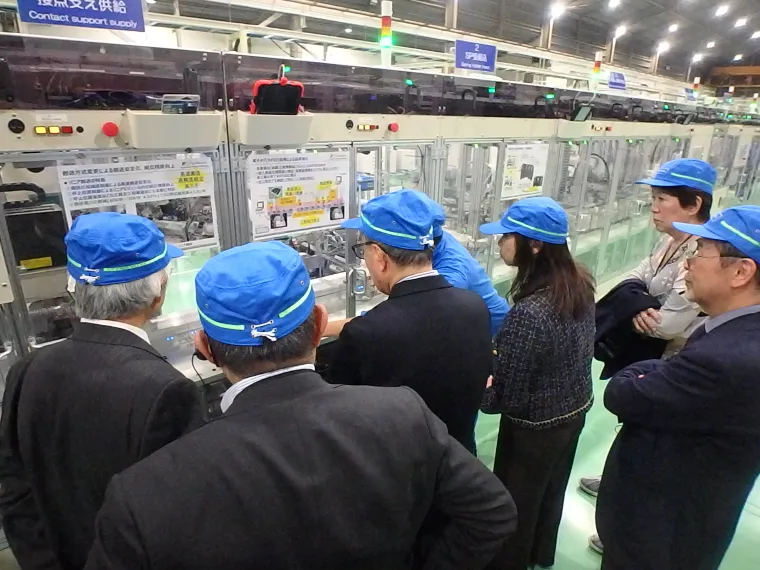
Before taking office, Outside Directors and Audit & Supervisory Board Members are briefed on the state of the Company and the roles they are expected to perform. After taking office, they have the chance to deepen their understanding of the Company through presentations on the strategies for business, R&D, and other operations, inspections of business bases, and other ways.
Outside Directors and Audit & Supervisory Board Members touring the ED&C components business (Fukiage Factory)
Main Opinions of Directors and Audit & Supervisory Board Members from the Survey and Interviews
Composition of the Board of Directors
Operation of the Board of Directors
Content of Board of Directors Matters for Deliberation and Reporting
In addition to diversity in nationality, it is important to cultivate human resources with an international outlook within the Company and give them management experience at overseas subsidiaries and elsewhere.
There were no cases in which insufficient deliberation time prevented adequate discussion. Open and vigorous discussions are being held.
We need to expand discussions on measures for addressing geopolitical risks and changes in national policies and international rules as well as on resilience and BCP.
The ratio of women should be increased gradually. Initiatives are also needed to cultivate and appoint female officers from within the Company.
In addition to tracking the performance of each business, we need to further expand opportunities to discuss topics such as the potential for new businesses from a medium-to long-term perspective.
We would like to see not only the conclusions of agenda items, but more of the process and background leading to decisions. Greater transparency around the process, including the criteria used to reach those decisions, would be beneficial.
We should appoint younger people who will lead the Company in the future and reflect their perspectives in discussions, thereby bridging generational differences in perceptions and overcoming organizational vulnerabilities.
We also need to deepen discussions on management and legal concerns with Outside Directors and Audit & Supervisory Board Members who have specialized expertise.
Results of Initiatives to Address the Major Issues Identified in the Fiscal 2025 Effectiveness Evaluation and the Policies on Initiatives in Fiscal 2026
ประเด็นสำคัญ
Results of Initiatives in FY2025
Policies for Major Initiatives in FY2026
Discussion of important medium-to long-term issues that contribute to corporate value enhancement
Discussion of medium-to long-term issues that contribute to corporate value enhancement
・ Human resource measures (human resource cultivation, promoting active participation of diverse human resources, etc.)
・ Sustainability Committee activity report
Continue to work to enhance opportunities to report on and discuss medium-to long-term issues that contribute to corporate value enhancement
・ Human resource strategy (medium-to long-term strategy and progress follow-up on measures, etc.)
The Nomination and Remuneration Committee discusses the validity of the policies, criteria, and levels of remuneration in light of changes in the operating environment, objective external data, and other matters and then reports to the Directors, and then the Board of Directors resolves on the policy for the final decisions respecting the details of the committee’s report.
The decision on specific remuneration amounts for individual Directors is left to the discretion of Michihiro Kitazawa, Representative Director, Chairman of the Board and CEO, but within the limit resolved at the General Meeting of Shareholders and with reference to the details of the committee’s report.
A predetermined fixed amount corresponding to each officer is paid at the set time each month
Standing Directors: No more than ¥450 million per year
Outside Directors: No more than ¥100 million per year
Standing and Outside Audit & Supervisory Board Members: No more than ¥120 million per year
B. Performance-linked remuneration
(Only Standing Directors are eligible for performance-linked remuneration)
a. Annual bonus
The amount paid is determined based on the consolidated ratio of operating profit to net sales for the previous fiscal year, which is set as an important target in the Medium-Term Management Plan as well as by comprehensively considering consolidated performance (net sales, operating profit, profit, dividend amount, etc.). The bonus is paid at the set time each year only when a dividend from surplus is paid to shareholders, and to more clearly link the total amount paid with the consolidated performance each fiscal year, the total amount is set at no more than 1.0% of the consolidated profit for the business year preceding the payment date.
b. Share-based remuneration
To more clearly link remuneration with the value of the Company's shares, the amount paid is determined based on the consolidated ratio of profit to net sales for the previous fiscal year as well as by comprehensively considering consolidated performance (net sales, operating profit, profit, dividend amount, etc.). In addition, the Company's shares corresponding to the above payment amount are granted at the set time each year only when a dividend from surplus is paid to shareholders, and the total number of shares granted per business year is capped at 42,000.
Remuneration by Officer Classification
การจำแนกประเภท
Total remuneration, etc.
(Millions of yen)
Number of
applicable officers
(person)
Base remuneration
Performance-linked
remuneration
Annual bonus
Share-based
remuneration
ทั้งหมด
1,180
475
706
433
273
16
Of which, Standing Directors
1,038
332
706
433
273
7
Of which, Standing Audit & Supervisory Board Members
63
63
—
—
—
2
Of which, Outside Directors and Outside Audit & Supervisory Board Members
We ensure the effectiveness of audits by strengthening cooperation between the statutory auditing function (Audit & Supervisory Board Members and Accounting Auditors) and the internal auditing function (the Internal Audit Office).
In addition, to strengthen audits across the entire Group, we collaborate with Audit & Supervisory Board Members and the Internal Audit Office of subsidiaries that are considered large companies under the Companies Act of Japan.
Audit & Supervisory Board Members conduct audits with a focus on strengthening the compliance of overseas subsidiaries and ensuring strict compliance with quality control and safety control rules.
The Audit & Supervisory Board reviews audit policies and plans, the appropriateness of Accounting Auditors’ auditing methods and results, and the assessments of Accounting Auditors. In addition, important matters are reported from the Standing Audit & Supervisory Board Member to the Outside Audit & Supervisory Board Members, and active communication takes place.
(For main audit implementation items, please refer to P60 “Supervisory and Auditing Bodies” – “Audit & Supervisory Board.”)
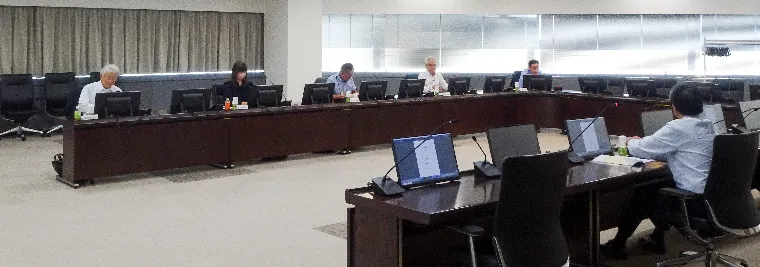
Meeting with the President and COO
การตรวจสอบภายใน
As a general rule, every second year the internal auditing divisions as bodies directly under the President and COO perform the following audits on Fuji Electric’s business divisions and subsidiaries so as to comprehensively cover the entire organization in accordance with the Internal Auditing Rules.
Regarding issues pointed out, we confirm the state of progress every quarter and implement follow-up audits as required.
In fiscal 2025, we conducted on-site audits at 46 bases, or about 50% of the audit bases.
Fuji Electric holds listed shares as a matter of policy in order to maintain and strengthen relations with its investee companies. Our basic policy is to reduce cross-shareholdings. Even in cases where we recognize a certain rationality in holding these cross-shareholdings, we will reduce them while paying attention to the impact on management and business.
Based on the above policy, we have reduced the number of different listed stocks we held from 102 as of the end of fiscal 2018 to 6 as of the end of fiscal 2024. As of the end of fiscal 2025, the number increased by 2 from the previous fiscal year to 8. This was due to the reclassification of shares as listed stocks following the new listing of unlisted stocks we held and the sale of some shares in affiliate companies that we held. In fiscal 2025, we also reduced the number of shares we held in some of these stocks.
The Board of Directors periodically evaluates the rationality of shareholding in light of whether it is necessary to maintain and strengthen relations with the investee companies and of the comparison of capital cost and return. The details of the review are disclosed.
The voting rights that come with cross-shareholding are exercised after considering all relevant factors, including whether the proposed action will help the issuing company to establish an appropriate corporate governance framework and to increase its medium- to long-term corporate value, and what impact the action will have on Fuji Electric. We also have dialogue regarding the details of the proposal, among others, with the issuing company as necessary.
The total amount of cross-shareholdings (including shares deemed to be held by the Company) at the end of fiscal 2025 was 99.6 billion yen (11.8% of consolidated net assets).