Three Key Challenges
in Japan’s Energy Supply-Demand Balance
――What challenges does Japan’s electric power industry face as it works toward a decarbonized society?
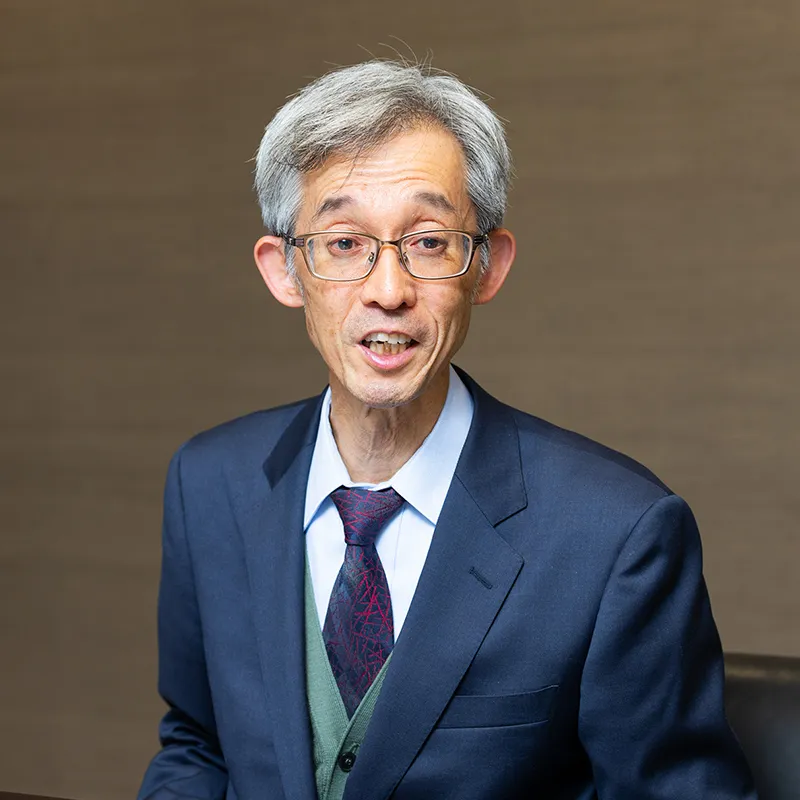
Professor, Graduate School of the University of Tokyo
President of the Japan
Society of Energy and Resources
Doctor of Engineering
Ryuji Matsuhashi
Matsuhashi Many countries and regions have declared their intention to achieve a carbon-neutral society by 2050, and Japan is now working toward this goal in line with the guiding principles of the 7th Strategic Energy Plan. The goal under this plan is for renewable energy to serve as a core power source representing 40–50% of the total by FY2040, with nuclear power accounting for 20% and the remaining 30–40% supplied by thermal power generation.
The problem is that these metrics are just averages. Solar power has the largest capacity among renewable energy sources, but it produces zero output at night, causing the proportions of each energy source to vary significantly depending on the time of day. Because nuclear power is primarily operated as baseload generation, the challenge lies in how it can contribute to the supply-demand balance.
Thermal power generation historically played the role of balancing supply and demand. If the share of thermal power decreases, balancing supply and demand will require using non-conventional power resources, such as storage batteries, electric vehicles, and home appliances. These new balancing resources are expected to be integrated broadly into the power reserve market. This is the first challenge.
The second challenge is that as the share of renewable energy increases, there will be insufficient inertia to ensure a stable power supply. Even if the balance between supply and demand is disrupted for some reason, thermal power has high inertia that can prevent rapid changes in frequency, whereas solar power generation has no inertia. The challenge lies in how to compensate for insufficient inertia to ensure a stable power supply.
The third challenge is uncertainty in power demand. While the widespread adoption of AI (artificial intelligence) will make life more convenient, it will also lead to massive power consumption. The development of AI-related data centers is accelerating, causing a surge in inquiries regarding connection to the power grid. Even if not all of these inquiries are fulfilled, electricity demand will still be significant. Even with advances in energy-saving technology, the extent to which electricity demand will increase in the future due to the expansion of facilities and other factors is uncertain.
Activating the Power Reserve Market
as Part of the Solution
――In light of these circumstances, the power reserve market has been attracting attention for its role in balancing supply and demand. Is the market performing well?
Matsuhashi Considering the expected decline in the supply of power reserves from thermal power generation, reserve capacity from other resources will need to be strengthened. The power reserve market is already open, and bidding has started. However, only one of the five categories is seeing favorable progress.
There are five categories in the market, which are based on the time required for supply, ranging from seconds to 30 minutes. Power reserve products are traded within these categories, but we are only seeing progress in the slowest, 30-minute products. Ultimately, all five categories will need to be traded in order to strengthen power reserves.
In the categories that are not functioning, there are few operators submitting bids at the bidding stage, resulting in the current deficiencies. This is due to the risk that future weather forecasts may be inaccurate, which makes participation in bidding highly risky.
There are also systematic design problems. The longest, 30-minute product requires bidding up to one day in advance, but for the remaining products, a whole week’s worth of bids must be submitted a week in advance. It's difficult to predict a week's worth of renewable energy with certainty, increasing the risk for bidding participants.
That said, applying the one-day-ahead system to all categories should stimulate the market, and further technological advances in grid-scale batteries are also anticipated. People say that grid-scale battery storage is in a transitional stage, but technically, it is already on standby. In particular, I believe that the development of total systems that integrate software and hardware for B2B is an area where the strengths of Japanese companies can be leveraged.
Providing One-Stop Support
for Operators Participating in the Market
――What can Fuji Electric do to encourage operators to participate in the power reserve market?
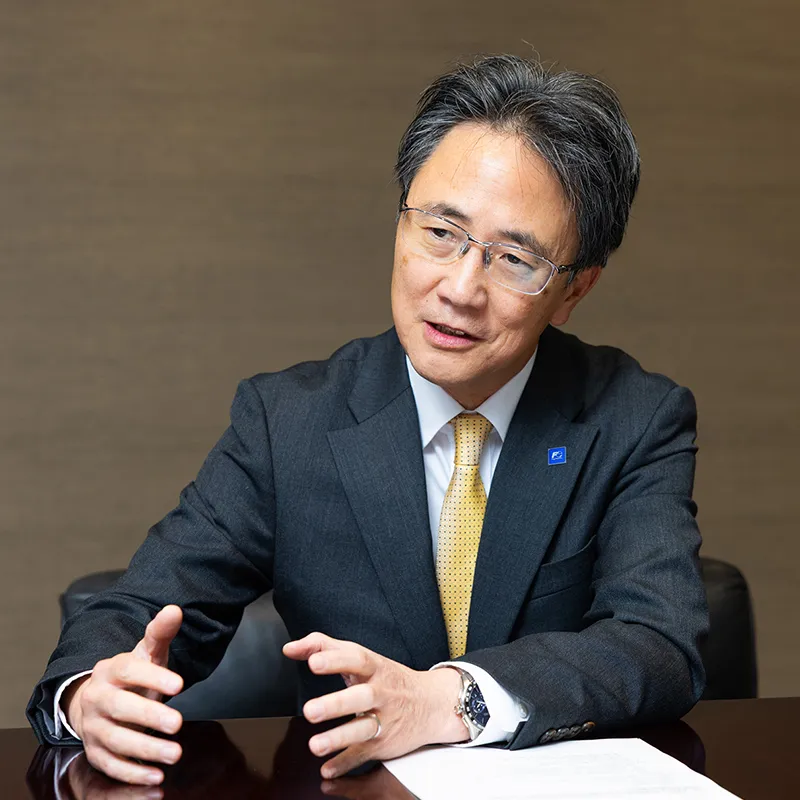
General Manager, Energy Management Division,
Energy Business Group, Fuji
Electric Co., Ltd.
Takeshi Ono
Ono Grid-scale battery storage plays an important role in society by providing power reserves. However, for operators, it is also crucial that this can function as a viable and sustainable business. To achieve this, it is essential to balance income and costs, as well as reduce the burden of deploying and operating systems. Fuji Electric, which has been developing businesses in the energy and environmental sectors, supports customers with the system technologies it has cultivated.
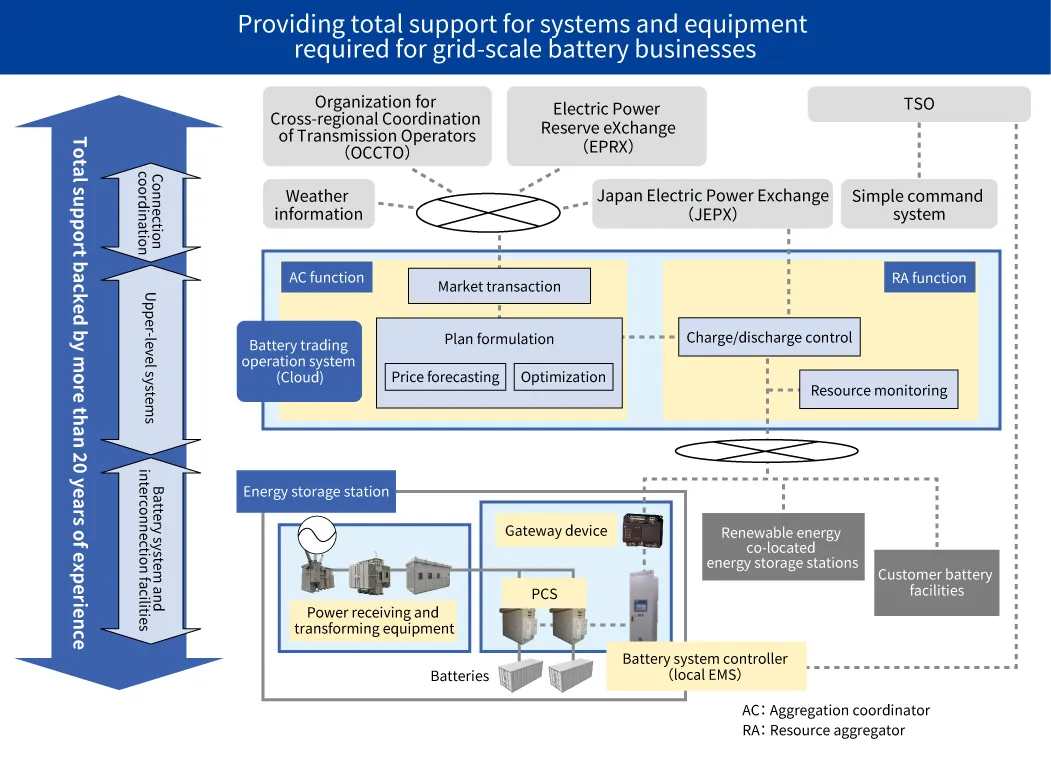
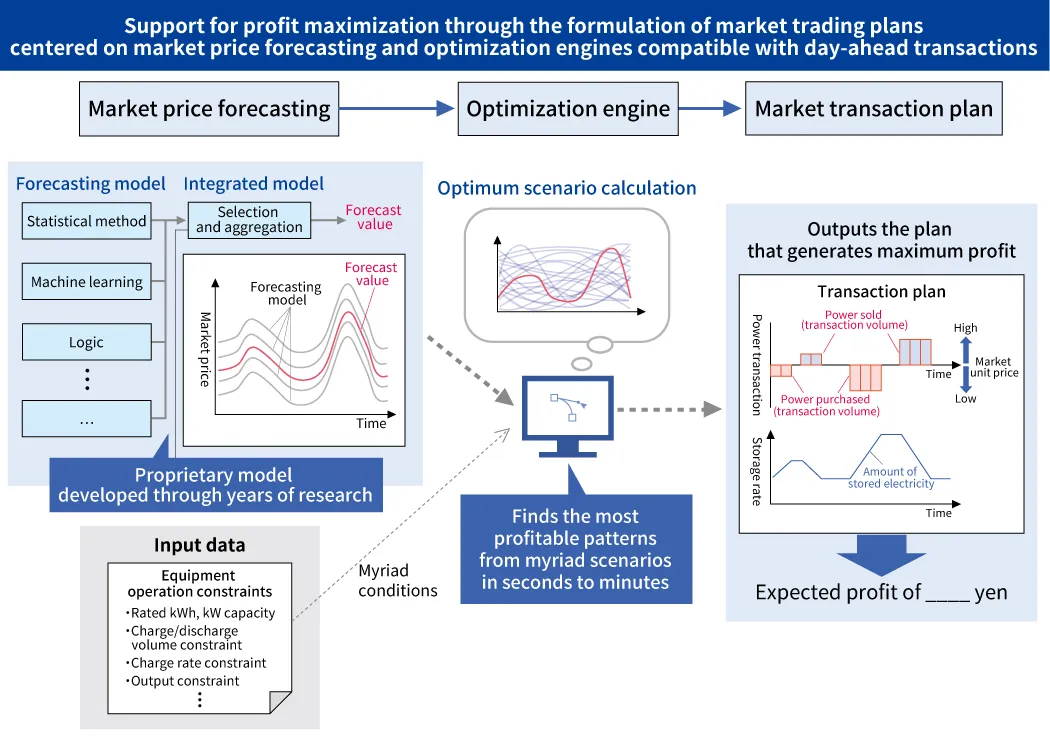
Maximizing profit requires accurately predicting market prices, as well as formulating and providing optimal trading plans. We provide battery trading operation systems built around market price forecasting and optimal battery planning capabilities. Our battery trading operation systems can be used to execute optimal transactions not only with our own battery systems, but also when using battery systems from other companies.
To reduce the burden of system deployment for customers, we provide total solutions that include battery trading operation systems, battery systems, and interconnection equipment. There are currently no standardized specifications for interfaces between higher-level systems (power market trading systems) and lower-level systems (battery systems). We can reduce the burden on customers by providing one-stop services. Of course, we also offer individualized services, allowing us to respond flexibly to customer requests.
Notably, our battery trading operation systems are equipped with an AC (aggregation coordinator) function for providing optimal trading plans, and the RA (resource aggregator) function for managing reserve power. These are available both separately and as a package, allowing solutions to be customized to each customer’s business model. Automation also reduces the labor required for operations.
In addition, we intend to develop these systems into multi-purpose systems that can handle transactions in the power reserve market and the wholesale electricity market using battery systems co-located with renewable energy facilities, as well as the battery systems of customers.
――Where does Fuji Electric’s competitive edge come from?
Ono We have spent years developing battery systems designed to stabilize the grid by building on the technologies used in uninterruptible power supply (UPS) devices and inverters equipped with power semiconductors. We have honed technologies for maintaining power quality through various projects, including the delivery of wind power stabilization demonstration equipment in 2004 and demonstration system facilities for island microgrids in 2009.
In addition, we have been working for many years on demand forecasting aimed at achieving a stable electricity supply. Our solutions in this area have been adopted by former general electric utilities and new electric power companies. Another one of our strengths is our focus on training engineers in relevant fields and maintaining a high level of technical expertise.
Supporting Our Customers’ Businesses
by Continuously Enhancing Systems
in Response to Changing Frameworks
――What kind of developments can we expect to see in the future?
Matsuhashi Based on the major trends over the past several years, we expect to see improvements in the power reserve market, as well as the implementation of a co-optimization market by around 2028. This represents a major reform that integrates the wholesale power market with the power reserve market, allowing kWh, ΔkW, and ΔkWh prices to be set at the same time.
This will enable economic rationality through overall cost optimization. However, participating operators will be required to develop new technologies and possess system development capabilities, including total system optimization models.
To this end, Japanese companies should be able to further leverage their strengths in delivering systems that integrate software and hardware. We have high expectations for Fuji Electric, which can provide meticulous services tailored to each company, including integrated control of different types of batteries and accurate forecasting of conditions using mirror models.
Ono When transitioning to new frameworks, such as day-ahead transactions or co-optimization markets, systems must evolve to meet the relevant requirements. We will strengthen our organization so that we can develop and deliver new required functions without delay.
In addition, as grid connection requirements become increasingly stringent, we have been leveraging our know-how to strengthen support for customers. At the same time, we are proactively gathering the latest information by participating in national demonstration projects and study groups to develop technologies to address inertial power shortages and evaluate grid codes.
Fuji Electric can integrate entire systems and has worked to develop core technologies. We will continue to expand our business and play a central role in stabilizing the grid, contributing to the realization of a decarbonized society.
We also took this opportunity to ask the Electric Power Reserve Exchange, which is the operator of the power reserve market, about its expectations regarding market participation using batteries and similar resources. Their response is presented below.