


Share





 Products & Solutions Top
Drives & Controls
UPS & Industrial Power Supply
Sensors & Measurements
Energy Management
Monitoring & Control System
Distributions & Controls
Transmission & Distribution
Transit System
Semiconductors
Energy
Food and Beverage Distribution
Service & Equipment Upgrades
Solutions
Products & Solutions Top
Drives & Controls
UPS & Industrial Power Supply
Sensors & Measurements
Energy Management
Monitoring & Control System
Distributions & Controls
Transmission & Distribution
Transit System
Semiconductors
Energy
Food and Beverage Distribution
Service & Equipment Upgrades
Solutions
Share
September 29,2009
Fujitsu Limited Fuji Electric Systems Co., Ltd.
Tokyo, September 29, 2009 – Fujitsu (Headquarters: Minato-ku, Tokyo; President and Representative Director: Michiyoshi Mazuka) and Fuji Electric Systems (Headquarters: Shinagawa-ku, Tokyo; President and Representative Director: Mitsunori Shirakura) today announced that they have jointly developed technologies for designing eco-friendly datacenters.
The technologies include a datacenter operation management system with energy consumption visualization technology, as well as a spot air conditioning system which prevents hot spots from emerging inside the datacenter (patents pending). These technologies promise to reduce CO2 emissions by 40% (*1) for IT facilities, including buildings, machine rooms, power supplies and air conditioners, which collectively account for over half of datacenter energy consumption.
The two companies plan to employ these technologies as the basis for an eco-friendly datacenter solutions business. Fujitsu Limited is currently applying these technologies at the new wing of its Tatebayashi System Center facility, in Tatebayashi, Gunma Prefecture, due to open in November 2009.
The technologies will be exhibited at the Fujitsu booth at CEATEC Japan 2009 from October 6–10 at Makuhari Messe.
About the Technologies
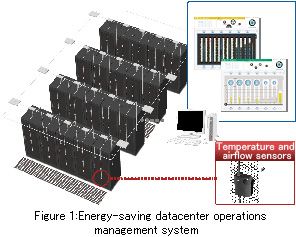
1. Energy-saving datacenter operations management system (Figure 1)
Fujitsu and Fuji Electric Systems have developed technology to visualize energy consumption, from extra high voltage power supplies to server racks, as well as the temperature and air conditioning conditions of a datacenter. Based on this data, the system can enhance datacenter energy efficiency and air conditioning control. This system comprises several key technologies, which are explained below.
2. Spot air conditioning system (Figure 2)
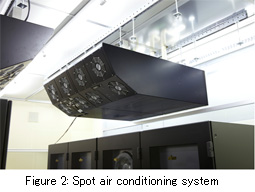
The spot air conditioning system was developed as a way to eliminate hot spots within a datacenter. The air conditioning system, which uses the headroom above each server rack, employs Fuji Electric Systems technology used in refrigerated showcases for compact, efficient cooling. The system monitors the utilization of IT hardware and operates at an optimal balance of spot and systemic air conditioning to reduce the cooling system's energy demands by roughly 25% over previous systems(*4).
3. Solar cells mounted to vertical noise baffles
Solar cells have been mounted on vertical noise baffles, something that was difficult to accomplish in the past. This takes advantage of lightweight film substrate solar cells from Fuji Electric Systems, and when used in combination with newly developed high-efficiency power conditioners, significant power savings can be achieved.
In addition to these jointly developed technologies, the new wing of the Tatebayashi System Center will benefit from a facility cooling design that uses outside air, common-area heating utilizing exhaust heat, and thermal flow simulations, all to conserve energy.
The two companies are each offering eco-friendly datacenter design solutions. Fujitsu is offering its Green Infrastructure Solution (*5), and Fuji Electric Systems is offering Green IDC (*6). Both companies expect that these technologies will be able to rapidly reduce the power consumption, electrical costs, and environmental footprints of the IT facilities at datacenters, and contribute to a reduced environmental footprint for society as a whole.
Glossary and Notes
All other company or product names mentioned herein are trademarks or registered trademarks of their respective owners.
Information provided in this press release is accurate at time of publication and is subject to change without advance notice.